
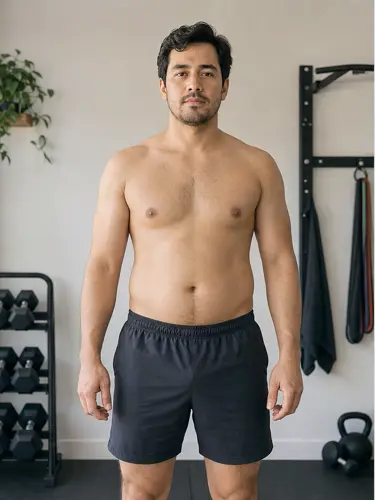
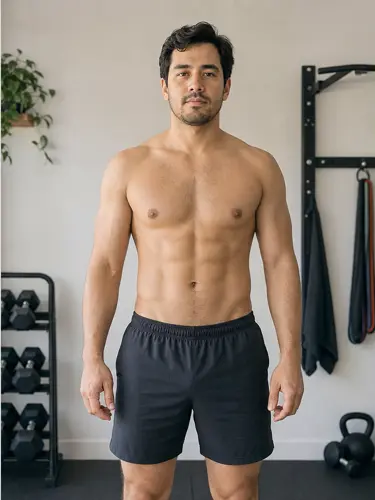
A large share of the abs before-and-after photos you see online are either the same body an hour apart, or not a photograph at all. AI image generation got good enough in the last couple of years that a fake transformation can pass a casual glance, and the old-fashioned tricks — lighting, posture, a pump, a tan — were already doing most of the work before that. This post is a practical guide to reading these images: the tells for a generated one, the tells for a real-but-misleading one, and what an honest before-and-after actually contains. The example images on this page are AI-generated, and they are labelled as such.
Why this suddenly matters
Before-and-after photos are the single most persuasive thing in fitness marketing, which is exactly why they are the most manipulated. Until recently the manipulation had a ceiling: you had to start with a real body and shoot it favourably. Now anyone can produce a photorealistic image of a person who does not exist, at any body fat, in any setting, in under a minute and for a few cents.
That is not automatically a bad thing. Used honestly — as a labelled illustration of a plausible goal, which is what this site does — it is a genuinely useful tool. Used dishonestly, presented as somebody’s real result to sell a program, it is straightforwardly a lie. Knowing which one you are looking at is now a skill worth having.
How to spot a generated image
Generated images have got very good at bodies and are still unreliable at the boring details around them. Look away from the abs and check these.
- Permanent marks. Moles, freckles, scars and tattoos should be identical in both frames, in the same places, at the same size. Tattoos are the strongest single tell — generated ones garble text and break up line work. A mole that moved is conclusive.
- Hands, teeth and ears. Still the classic weak points. Count fingers, look for a thumb on the wrong side, check that both ears have the same structure.
- The background. In a real pair shot months apart, the room is the same but the clutter is different. In a generated pair, the background is often too consistent, or subtly nonsensical — a tile grid that does not line up, a door frame that bends, a mirror reflecting the wrong thing.
- Fabric logic. Waistbands are hard. Look at whether the shorts actually sit on the hips, whether the drawstring goes somewhere, whether a seam continues around the body.
- Skin texture uniformity. Real skin has uneven pores, stray hairs, blemishes and razor bumps. Generated skin often has an even, slightly waxy quality across the whole torso, with no region that looks worse than another.
- Lighting that does not agree. Check the direction of every shadow — under the pecs, under the chin, on the wall. Generated images frequently light the body from one direction and the room from another.
One caution: none of these are proof on their own. Compression, filters and a phone’s own beauty processing can produce waxy skin in a real photo. Treat the tells as a stack, not a single test.
How to spot a real photo that is still lying to you
This is the more common problem and it predates AI by thirty years. Every item below can be done to the same body on the same afternoon.
- Posture. The “before” is shot relaxed, shoulders forward, belly pushed out, hips tilted. The “after” is braced, chest up, lats flared. This alone is worth several apparent inches.
- Lighting. Flat, straight-on light in the before; overhead or angled light in the after, which casts the shadows that make abs read. Same body, half the definition.
- The pump and the meal. After frames are shot post-training and usually after a low-carb, low-sodium, low-water day. The stomach is genuinely flatter for a few hours.
- Tan, oil, shaving, and hair. A tan increases apparent contrast, and body hair hides definition. A haircut between the two shots is a small tell that the photos were taken to be compared.
- Camera and crop. Different distance and lens change body proportions substantially. A before shot from slightly below and an after from eye level are not comparable.
- No dates and no numbers. If a transformation does not state how long it took and what the weights were, assume the timeline is the least flattering part of the story.
What an honest before-and-after contains
If you are assessing someone else’s, or documenting your own, this is the checklist. It is not complicated, which is rather the point.
- Same room, same light, same time of day, same camera position.
- Same pose, relaxed, arms at your sides. No bracing in one and not the other.
- Both dates stated, and both body weights.
- The elapsed time stated plainly. Six months is an impressive honest answer; “before and after” with no number is not an answer.
- Any AI generation, retouching or filtering disclosed.
For your own progress photos, the practical version is: same corner of the same room, morning, before eating, once a fortnight, arms down, no flexing. You will hate the first one. That is what makes it useful in month four, when you cannot see any change in the mirror and the photo proves otherwise.
Where AI images fit honestly
There is a legitimate use for a generated body image, and it is not proof. It is a target. A rendering of your own photo at a lower body fat is a personal reference point — more honest, arguably, than the usual alternative of comparing yourself to a genetically unusual stranger at the leanest week of their year.
The line is disclosure. An image offered as “here is a body fat level you could plausibly reach, rendered on you” is a goal-setting tool. The same image offered as “here is what our program did for this customer” is a fabricated testimonial. We go into how the underlying tools differ from overlay filters in abs filters vs. AI body transformations.
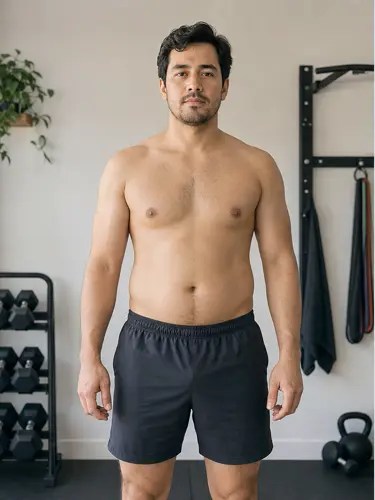
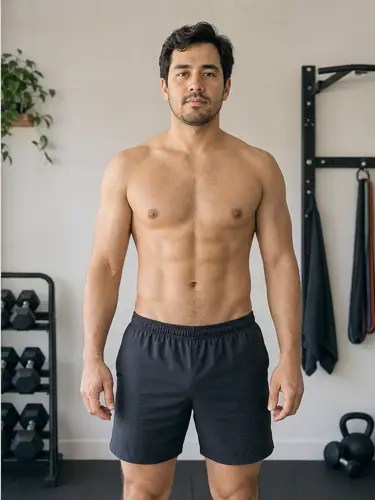
The pair below is an illustrative example: a starting photo and an AI rendering of the same subject at a lower body fat. It is not a record of anyone losing weight, and we would not present it as one.
The useful question to ask instead
Somebody else’s before-and-after tells you almost nothing about your own, because you do not share their starting body fat, their muscle, their fat distribution or their schedule. The genuinely informative version is your own numbers: where you are, where the threshold is, and how many weeks sit between them. The free abs timeline calculator works that out in about ten seconds, and our post on how long it takes to get visible abs covers what the timeline actually depends on.
And if you want to see the after half of your own pair before you have earned it, Abs By AI renders it from one photo in about 30 seconds — your face, your frame, clearly labelled as AI-generated every time. Three free tries, no credit card.
Example images are AI-generated illustrations of a possible outcome, not real transformations and not guarantees of results. Nothing here is medical advice — talk to your doctor before starting a diet or exercise program.
Leave a Reply