
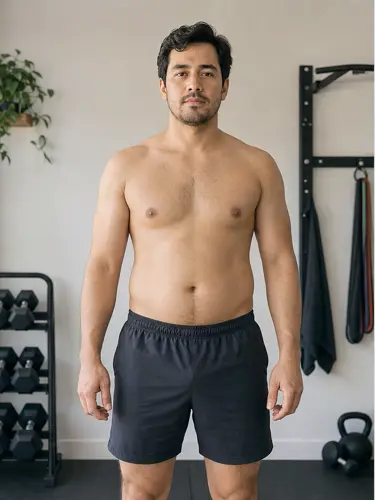
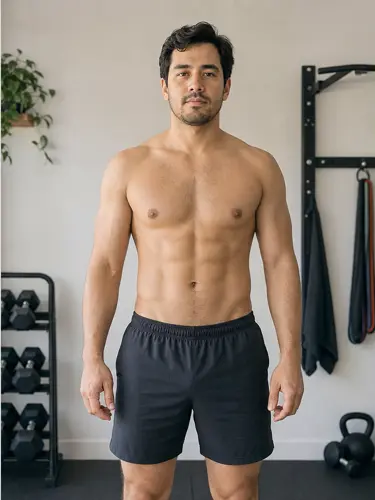
You’ve dropped ten, maybe fifteen pounds. Your face looks leaner, your jeans fit better, and your friends have started asking what you’re doing differently. Then you look in the mirror at the two soft pads sitting above your hips, and they haven’t moved an inch. Love handles are almost always the last thing to go, and for most people they’re the reason a fat loss phase feels like a failure even when the scale says otherwise.
There’s a physiological reason this spot is so stubborn, and once you understand it, the frustration mostly disappears — because you stop expecting a single ab circuit to fix a problem that isn’t really about your abs at all.
Why fat clings to your obliques longer than anywhere else
Fat cells aren’t distributed evenly across your body, and they don’t respond to hormones the same way in every location. The area around your waist and lower back is dense with alpha-2 receptors, which are far less responsive to the fat-mobilizing signal from adrenaline than the beta receptors found in places like your arms or upper chest. Your body is, in a sense, protecting this fat store. From an evolutionary standpoint it makes sense — it’s insulation around vital organs, and it’s the last reserve your body wants to burn through. That biology doesn’t care how many crunches you did this week.
This is also why two people at the same body fat percentage can look completely different around the midsection. Genetics decides where your particular alpha-2 receptor density is highest, and no amount of targeted training changes that map.
Spot reduction doesn’t work, but spot training still matters
You cannot choose which fat cells shrink first through exercise selection. Decades of research on this are consistent — training one side of the body doesn’t preferentially burn fat from that side. But that doesn’t mean oblique-focused training is pointless. Strengthening the muscles underneath the fat changes the shape of what’s left once the fat does come down, and it improves the transition from waist to hip that makes love handles look more pronounced than the fat percentage alone would suggest. Think of it as improving the canvas, not erasing the paint.
The deficit has to be real, not just directionally correct
Most people who feel stuck at the love handle stage aren’t actually in a fat loss plateau — they’re in a maintenance range they haven’t noticed yet. Metabolic adaptation, unconscious calorie creep from “healthy” snacking, and underestimating portion sizes after a few months of dieting all conspire to slow progress right around the point where stubborn fat becomes the main visible obstacle. Tracking food again for even one week, weighing rather than eyeballing portions, is usually the fastest way to find out whether you’re actually still in a deficit or just going through the motions of one.
Sleep and cortisol are doing more damage than people assume
Chronic under-sleeping and constant low-grade stress push cortisol higher for longer stretches of the day, and cortisol has a documented relationship with abdominal and flank fat storage specifically. This isn’t a minor footnote — someone sleeping five hours a night and grinding through back-to-back stressful weeks can eat a technically correct diet and still hold onto waist fat that a better-rested, less stressed version of themselves would have shed already. Fixing sleep won’t melt love handles overnight, but ignoring it while blaming your diet plan is a common and avoidable mistake.
What actually moves the needle
Combine a real, sustained calorie deficit with resistance training that includes rotational and anti-rotational core work — think cable woodchoppers, side planks with reach, and loaded carries — rather than endless crunches. Add two to three sessions of higher-intensity cardio per week to help with the overall energy deficit, since love handles respond to total body fat reduction more than any single exercise. Protein intake around 0.8 to 1 gram per pound of body weight preserves the muscle underneath while you’re cutting, which matters because that muscle is what defines your waistline once the fat layer thins out.
Gravity Transformation’s video “11 Simple Tricks to Lose Love Handles Fast” walks through a practical set of adjustments — food swaps, movement patterns, and daily habits — that stack on top of the fundamentals above. It’s worth watching for the specific, actionable tweaks rather than as a replacement for the deficit and training work that has to happen underneath it.
Give the changes above six to eight weeks before judging them. Love handles move slower than most other fat, and slower doesn’t mean it isn’t working.
Leave a Reply