
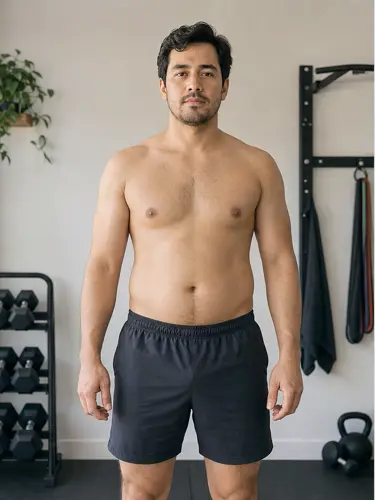

You’ve been at this for months. The scale barely moves, your waistband feels a little looser some weeks and tighter the next, and every time you catch yourself in a mirror under bad lighting, you still can’t tell if you’re building anything or just losing what little muscle you started with. This is the exact spot where most people quit — not because they lack discipline, but because nobody ever taught them how to decide what to do next.
The decision that trips people up more than any other is whether to cut (eat less, lose fat) or bulk (eat more, build muscle). Get this wrong and you can spend a year working hard in the wrong direction. For anyone chasing visible abs specifically, this decision matters more than it does for almost any other goal, because abs are the one muscle group where both sides of the equation — muscle definition and fat covering it — have to line up at the same time.
Skinny-fat isn’t a body type — it’s a mismatch
People throw the term “skinny-fat” around like it describes a category of person. It doesn’t. It describes a mismatch between two numbers: your body fat percentage and your muscle mass. Someone can weigh 150 pounds and look thin in a t-shirt while still carrying 22-24% body fat with almost no muscle underneath it. Take the shirt off and the stomach looks soft, not lean — because there’s nothing under the fat pushing it taut.
This matters because the instinct almost everyone has is to treat this as a fat problem and go straight into a calorie deficit. That instinct is usually wrong, and it’s wrong for a specific, physiological reason.
Why cutting first usually backfires here
When you’re in a calorie deficit, your body pulls energy from two places: stored fat and muscle tissue. How much comes from each depends heavily on how much muscle you have to begin with and how hard you’re training. Someone with a solid strength base and years of consistent training can diet down aggressively and hold onto nearly all their muscle, because their body has a strong incentive to protect tissue it worked hard to build and is actively being told to keep (via heavy lifting) during the diet.
Someone who is skinny-fat doesn’t have that leverage. There’s less established muscle to protect, and often the training history isn’t there yet to signal the body to prioritize keeping it. Cut calories under those conditions and a meaningful share of what you lose comes from muscle, not fat. Six months later you’re lighter, sure — but softer in the exact places you wanted to look sharper, because you’ve shrunk the muscle that was supposed to be showing through.
The two questions that actually decide this
Skip the personality-quiz approach to this decision. Two variables do almost all the work: your current body fat percentage, and how much serious resistance training you’ve actually done.
If you’re carrying a lot of visible fat — think noticeably rounded midsection, no visible ab shadowing even when flexed — a short, moderate cut usually needs to come first, regardless of training age. Past a certain body fat threshold, no amount of muscle underneath will show, so there’s nothing to protect yet by holding off. But if your body fat is moderate and your training history is thin (less than a year of consistent, progressive lifting), building muscle first is almost always the better trade. You get more return per pound of bodyweight change, and you build the tissue that a future cut will actually reveal.
What building muscle first actually requires
This isn’t a green light to eat whatever you want under the banner of “bulking.” A slow, controlled surplus — something like 200-300 calories above maintenance — paired with a protein target around 0.8-1 gram per pound of bodyweight and a progressive lifting program will build muscle without piling on much fat. The pace here is slower than most people expect: a half pound to a pound of gain per week is realistic, and pushing faster than that just adds fat you’ll have to cut later anyway.
Track waist measurement alongside the scale during this phase, not just weight. If your waist is growing at nearly the same rate as your overall weight, the surplus is too large. If it’s holding steady while the scale creeps up, you’re doing it right.
Why this hits abs harder than any other muscle
Biceps and shoulders look bigger the moment you build muscle there, fat covering or not. Abs are unusual — the muscle can be fully developed and still invisible under a layer of fat that most other muscle groups would hide just fine. That’s the mechanism behind the common complaint of doing hundreds of crunches with nothing to show for it. The muscle may already be there. It’s the decision about cutting versus building that determines whether anyone will ever see it.
Dr. Mike Israetel of Renaissance Periodization breaks this exact decision down with a level of specificity most fitness content skips entirely — he walks through where the actual cutoffs sit and how to self-assess which category you fall into without guessing. If you’ve been stuck deciding which direction to go, his video is worth the sixteen minutes; it will likely save you from a wasted season of training in the wrong direction.
Figure out which side of that line you’re actually on before you touch your calories again. Everything else — the workout split, the supplement stack, the meal timing — is a rounding error next to getting this one decision right.
Leave a Reply