
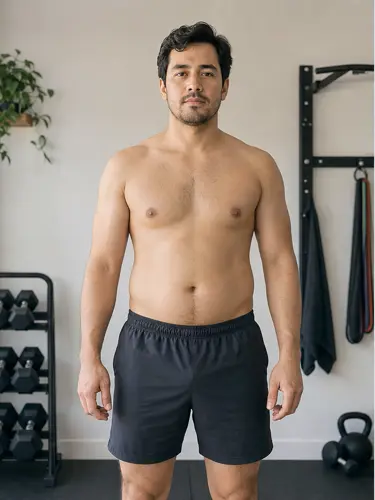

Sleep, appetite and training performance can change together. A scale cannot identify muscle loss or diagnose its cause.
This article looks at sleep research and practical ways to keep a record of rest and exercise. Studies report group-level findings.
What researchers measured in a sleep study
In 2010, researchers at the University of Chicago ran a crossover trial that is still the cleanest demonstration of this effect. Overweight adults spent two weeks on an identical calorie deficit, twice. During one stretch they were allowed 8.5 hours in bed. During the other, 5.5 hours.
Total weight lost came out roughly the same both times — around three kilograms. What changed was the composition of that loss. On adequate sleep, a little over half the weight came off as fat. On restricted sleep, fat loss dropped by about 55 percent, and the shortfall was made up by lean tissue. Same food, same deficit, same people. Only the sleep differed, and the body quietly decided to burn muscle instead.
Participants also reported being hungrier and less satisfied during the short-sleep phase, despite eating exactly the same amount. They were given no choice about their food, so the hunger never turned into extra calories. In your life, it would.
What your appetite does on five hours
Sleep loss can affect appetite in different ways. It is difficult to infer the effect on one person from a single night or a hormone measurement.
The appetite that shows up isn’t generic, either. Short sleep shifts cravings specifically toward calorie-dense, carbohydrate-heavy food, and it dampens activity in the prefrontal regions that would normally talk you out of it. So you get a stronger pull toward the worst options paired with a weaker brake.
A 2022 trial at the same institution ran the experiment in reverse. Habitual short sleepers — real people in their own homes, no lab feeding — got a single session of coaching on extending their sleep. They gained about 1.2 hours a night, and their spontaneous calorie intake dropped by roughly 270 calories a day. Nobody told them to eat less. They just did.
Run that out over a year and it’s meaningful territory. It came from going to bed earlier.
The insulin problem nobody warns you about
Four nights of restricted sleep is enough to measurably blunt insulin sensitivity in fat cells themselves — by something close to 30 percent in one study. Your pancreas compensates by pushing out more insulin to do the same job.
An isolated change in appetite or waist size cannot establish someone’s insulin level. A clinician can interpret concerns about blood sugar in context.
The visceral fat connection is the part worth taking seriously. Habitually short sleep tracks with deeper abdominal fat accumulation across multiple large cohorts — the kind packed around the organs, which is metabolically noisier than the layer you can pinch.
Your training takes the hit too
Under-slept lifters don’t produce less force on a single max effort — that part holds up surprisingly well. What collapses is everything around it. Total volume drops. Reps in reserve get misjudged. Perceived exertion rises for the same load, so sets that used to feel like an eight now feel like a ten and you cut them short.
Muscle protein synthesis also runs lower after sleep restriction, which matters enormously when you’re in a deficit. The whole point of lifting while dieting is to give your body a reason to keep the muscle. Poor sleep weakens that signal right when you need it loudest.
What to actually change
The gap between what people think they sleep and what they measure is usually 30 to 45 minutes. Eight hours in bed is not eight hours asleep. If you want seven and a half hours of sleep, you need something closer to eight and a quarter hours of opportunity.
A fixed wake time does more than a fixed bedtime. Your circadian system anchors to light and to consistency of rising, and the sleepiness sorts itself out on the back end within a few days.
Caffeine has a quarter-life problem, not just a half-life problem. A 2pm coffee still has meaningful caffeine in your bloodstream at 10pm. You may fall asleep on it — plenty of people do — but deep sleep takes the damage silently.
Alcohol is the one people defend hardest. It sedates rather than produces sleep, and it suppresses REM in the back half of the night. Two drinks with dinner is a measurable dent in overnight recovery, on top of the calories.
Keep the room cool. Core body temperature needs to drop about a degree Celsius to initiate and hold sleep, and a warm bedroom fights that directly. Somewhere in the 65–68°F range works for most people.
Worth watching
Dr. Matthew Walker, who runs the Center for Human Sleep Science at UC Berkeley, walks through the hormonal mechanics of this in the video below — particularly the cortisol and fat-storage relationship, and why late-night habits undo daytime discipline. He’s the person who has spent the most time with this literature, and hearing him lay out the sequence makes the abstract numbers feel considerably more urgent.
It runs about twelve minutes. Worth it before you plan another training block.
None of this replaces a deficit. You cannot sleep yourself lean while eating in surplus, and anyone selling that is selling something. But if you’ve been grinding an honest deficit for weeks and the composition of your loss looks wrong — strength sliding, softness persisting, hunger unmanageable by Thursday — the answer may not be another 200 calories off your intake. It may be an hour earlier, tonight.
Leave a Reply