
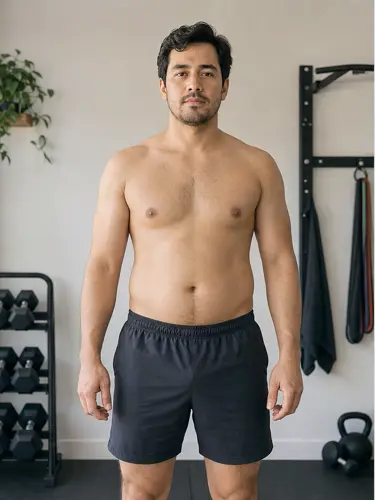

For most women the first faint ab outline appears around 22% body fat, and a clear, consistently visible set arrives around 19–20%. Those numbers sit roughly eight points above the equivalent male figures, and that gap is biology rather than a fitness gap — a woman at 19% is doing physiologically the same thing a man at 11% is doing. Below is the full range, why your personal threshold might sit either side of it, the point where going leaner stops being a good idea, and how to turn your own numbers into a timeline.
The thresholds for women
| Body fat | What you see |
|---|---|
| 28%+ | No abdominal definition |
| 25–27% | Flatter stomach, waist visibly narrower, no ab lines |
| 22–24% | Faint upper outline in good overhead light |
| 19–21% | Visible upper abs most of the time, obliques starting to show |
| 16–18% | Full set including lower abs; athlete territory, harder to maintain |
| 14–15% and below | Stage-lean. Not a year-round condition — see the warning below |
Most women who say they want “abs” are describing the 19–21% row: a flat stomach with a visible upper set and a defined waist. That is a demanding but genuinely maintainable place to live. The rows below it get progressively more expensive in ways that have nothing to do with willpower.
Why the numbers are higher than for men
Essential fat — the fat the body structurally requires to function — is roughly 3–5% of body weight for men and about 10–13% for women. Some of that sits in the breasts, hips and thighs and around the reproductive organs, and it is not optional or trainable. A woman’s entire scale is shifted up by that difference before anything else is considered.
This is worth internalising, because comparing your number to a man’s is the single most common way women end up feeling behind while doing everything right. Twenty-two percent on a woman and fourteen percent on a man are roughly the same achievement. Our post on the body fat percentage needed to see abs has the full side-by-side table for both.
The floor, and why it matters more for women
Chasing the bottom rows of that table has a real cost, and it is not vague. When energy availability stays too low for too long, the body downregulates functions it treats as non-essential. In women this commonly shows up first as a disrupted or absent menstrual cycle, and can come with worse sleep, low mood, persistent cold, hair thinning, reduced bone density and stalled training progress. Sports medicine treats this as a recognised syndrome rather than a sign of discipline.
Practical version: a missing period during a diet is not a badge and it is not something to push through. It is a signal to eat more, and to talk to a doctor rather than to a training forum. Competitors who hold 13–15% do it for a matter of weeks, with a plan for coming back up, and often not without consequences.
None of that is a reason to avoid getting lean. It is a reason to pick 19–21% as the target and stop there, which is where nearly everyone reading this actually wants to be anyway.
Why your own number may differ
Where you store fat. Women broadly fall into two patterns. If you carry weight on the hips and thighs, your stomach can look flat and defined while you are still well above 22% — you will see abs earlier than the table says, and the lower body will be the last to change. If you carry it centrally, the reverse: arms and legs lean out while the midsection holds on, and you will need to go a few points lower. Neither is better, and neither is changeable.
How much ab muscle you have built. Visible abs are a relief map. Women who have trained the midsection with actual resistance — weighted, progressive work, not endless bodyweight reps — will show definition several points earlier, because there is more to see. This is the fastest legitimate way to move your personal threshold up.
Water and the cycle. Abdominal definition can genuinely come and go across a month through fluid shifts, quite independently of fat. Judge progress across cycles, at the same phase, rather than day to day. A stomach that looks flat on Tuesday and soft on Friday has not gained fat.
Age and pregnancy history. Skin elasticity and, for some women, abdominal separation after pregnancy affect how a lean midsection reads. Separation is worth having assessed properly rather than trained around by guesswork.
How to measure where you are
The free option that works well enough is the U.S. Navy tape method, which for women needs four measurements: height, neck, natural waist and hips — men only need three, so a calculator that does not ask for your hips is not doing the female formula and its number is not reliable for you.
- Measure first thing in the morning, before eating, tape snug but not compressing.
- Waist at the narrowest point; hips at the widest point of the glutes; neck just below the larynx.
- Expect roughly 3–4 points of error. Use it for the trend, not the decimal.
Smart scales are convenient and swing several points with hydration alone. A DEXA scan is the practical gold standard at around $50–150 and is worth doing once for a real baseline, not monthly. Whatever you pick, do not change methods mid-diet and then panic at the jump.
Turning it into a timeline
The arithmetic is the same as for men, with your own threshold. Lean mass is your weight times (1 minus your body fat). Goal weight is that lean mass divided by (1 minus your target body fat). The difference is the fat to lose.
A 155-pound woman at 32% is carrying about 105 pounds of lean mass. At 20% she would weigh about 132 pounds — roughly 23 pounds of fat, or about six months at a pound a week. Aim for around half a pound to one pound weekly; faster than about 1% of your body weight per week and you start trading away the muscle that makes the abs visible in the first place.
The free abs timeline calculator runs the female formula and returns two calendar dates, one for the first outline and one for a clear set. Our post on how long it takes to get visible abs covers what usually stretches that timeline in practice.
Or see it instead of calculating it
A percentage is an abstraction, and it is a poor description of what you will actually look like. Abs By AI takes one photo and renders a realistic preview of you at a lower body fat — same face, same frame, same skin tone — in about 30 seconds. Three free tries, no credit card.
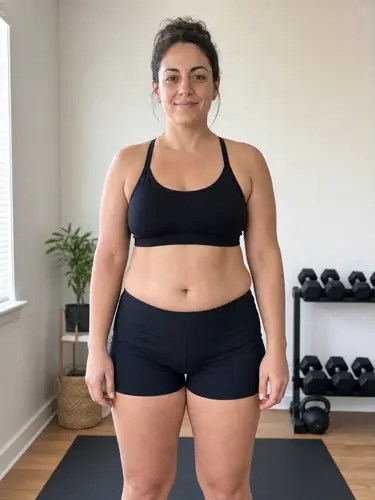
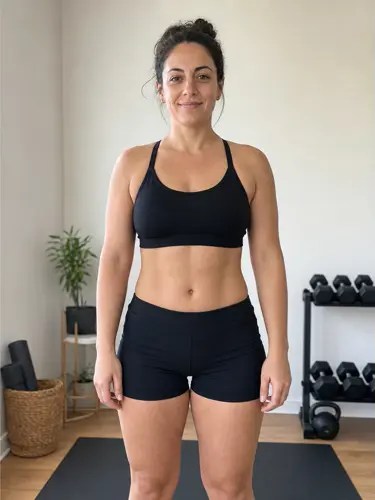
Example images are AI-generated illustrations of a possible outcome, not guarantees of results. Body fat thresholds are general guidance, not medical advice — talk to your doctor before starting a diet or exercise program, and especially if your menstrual cycle changes while dieting.
Leave a Reply