
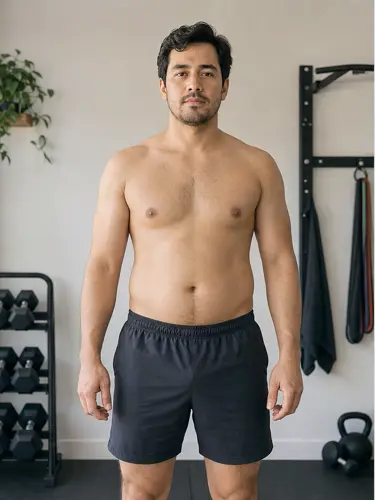
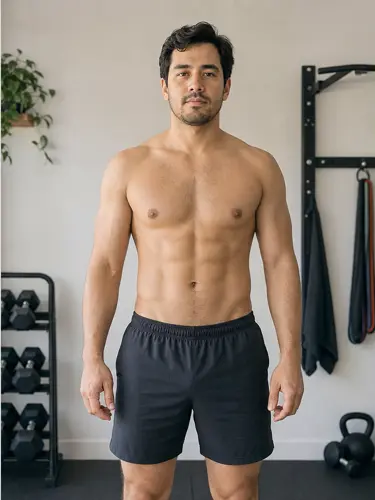
For most men, abs start to outline around 15% body fat and become a clear six-pack around 10–12%. For most women, that is roughly 22% and 19–20%. Those numbers are reliable enough to plan around, but they are averages, and the gap between two people at the same body fat can be large. This post explains what moves the number for you specifically, and how to measure where you are without paying for a scan.
The thresholds
| Body fat | Men | Women |
|---|---|---|
| No definition at all | 20%+ | 28%+ |
| Flat, faint outline in good light | 15–18% | 22–25% |
| Visible six-pack most of the time | 10–12% | 19–20% |
| Deeply etched, veins, stage-lean | 6–8% | 14–16% |
The male and female columns are about three to eight points apart at every row, and that gap is not a fitness gap. Women carry more essential fat — the fat the body requires to function, stored in part around the breasts, hips and thighs. Essential fat is roughly 3–5% of body weight for men and 10–13% for women. A woman at 19% is doing the same thing physiologically that a man at 11% is doing.
That bottom row is worth a warning. Stage-lean is not a lifestyle. Competitors hold it for a weekend, not a year, and holding it long-term tends to cost people sleep, mood, sex drive and, for women, menstrual regularity. If your goal is to look good with your shirt off, the third row is the target, not the fourth.
Why two people at 12% look different
Three things move your personal threshold, and none of them are under your control in the short term.
How big your abdominal muscles are. Visible abs are a relief map: the muscle has to stick up far enough for the shadow between the segments to read. Someone who has trained abs directly for years will show a six-pack several points of body fat earlier than someone who has never done a weighted ab exercise. This is the single biggest reason people arrive at their goal body fat disappointed — they got lean, but there was not much underneath.
Where you store fat. Fat distribution is genetic. Some people carry it evenly and lean out uniformly. Others hold it almost entirely in the lower abdomen, which means their arms, chest and face can look shredded while the stomach still looks soft. If that is you, you will need to go a few points leaner than the table suggests, and there is nothing you can do to change the order.
How many segments you have. The rectus abdominis is divided by connective tissue into segments, and the number and symmetry of those divisions is inherited. Some people have four, some have eight, some have a visible offset where one side sits higher. No amount of training changes it. A “four-pack” at 9% body fat is not an unfinished six-pack.
How to measure where you actually are
Every method has error. What matters is picking one and using it consistently, because the trend is more useful than the absolute number.
- Tape measure (U.S. Navy method) — free, about 3–4 points of error. You need waist, neck, height, and hips for women. This is the best value option and the one our calculator uses.
- Smart scale — cheap, unreliable in absolute terms. Bioelectrical impedance is heavily affected by hydration, so the reading can swing several points between morning and evening. Useful for trend only, and only if you weigh at the same time under the same conditions.
- Calipers — cheap and accurate in trained hands, poor in untrained ones. Measuring your own back and thigh sites is genuinely difficult.
- DEXA scan — about $50–150, the practical gold standard. Worth doing once for a real baseline if the number matters to you. Not worth doing monthly.
Whichever you choose, do not switch methods mid-diet and then panic. A caliper reading of 18% and a smart scale reading of 24% on the same body on the same day is entirely normal.
Turning your number into a plan
Once you know roughly where you stand, the arithmetic is simple. Your lean mass is your weight times (100% minus your body fat). Assume you keep that lean mass — which is the whole reason to lift and eat enough protein while dieting — and your goal weight is your lean mass divided by (1 minus your target body fat).
A 160-pound woman at 33% body fat carries about 107 pounds of lean mass. At 19% she would weigh about 132 pounds. At one pound a week, that is around seven months. Our free abs timeline calculator does this in about ten seconds and gives you an actual calendar date.
Or see the target instead of computing it
A body fat percentage is an abstraction. If you would rather see what your own body looks like at the threshold, Abs By AI takes one photo and renders a realistic preview in about 30 seconds — same face, same frame, lower body fat. Three free tries, no credit card.
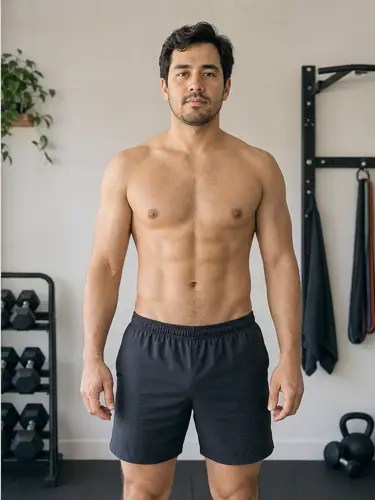
Example images are AI-generated illustrations of a possible outcome, not guarantees of results. Body fat thresholds are general guidance, not medical advice — talk to your doctor before starting a diet or exercise program.
Leave a Reply