
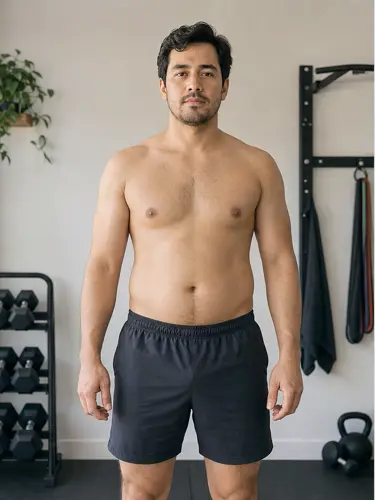

Yes, but not the way most people are sold on it — and there is a version of it that makes you less likely to succeed. Apps that let you see yourself fit or muscular are fitness goal visualization tools, not filters and not fitness plans. Used one way, a picture of your realistic future body gives you a concrete target and keeps you going in month four when the novelty is gone. Used another way, it becomes a pleasant daydream that quietly drains the urgency to do anything. The difference is not the app. It is what you attach the picture to.
What these apps actually are
Three different things get lumped under the same search results, and they do not do the same job.
- Filters and photo editors. They draw a pre-made ab or muscle overlay on top of your torso. Fast, funny, and they never looked at your body — so they cannot tell you anything about it. We compare the two directly in abs filters vs. AI body transformations.
- Tracking apps. Scans, measurements, progress photos. These tell you where you are, which is useful, and nothing at all about where you are going.
- Goal visualization. A generative model re-renders your actual photo at a lower body fat, keeping your face, frame, lighting and skin tone. The output is a picture of a destination rather than a record of the present. That is the category this post is about, and the mechanics of how it works are covered in our post on AI body transformation apps.
Why a picture works where a number does not
Most fitness goals are stated as numbers: 12% body fat, 175 pounds, a size 32 waist. Numbers are precise and almost completely unmotivating, because nobody wants a number. What people actually want is how they expect to feel walking into a room at that number, and a figure on a scale does not carry any of that.
A picture does two useful things a number cannot. It makes the goal specific — you stop chasing “in shape,” which is undefined and therefore never achieved, and start chasing a particular version of yourself you can recognise. And it makes it personal. The default reference image most people use is a stranger with different genetics, a different frame and probably a different decade of training behind them. Comparing yourself to that is demoralising in a way that comparing yourself to a leaner version of your own photo is not.
There is a third, unglamorous benefit: it is a reference point that does not drift. Six weeks into a diet you stop being able to see your own progress, because you look at yourself every day. Having a fixed before and a fixed target gives you two ends of a line you are actually somewhere on.
The part where it backfires
Here is the honest half, and it is not what a fitness app usually tells you. Research on mental imagery has a consistent and slightly uncomfortable finding: simply enjoying a vivid fantasy of having reached a goal tends to reduce the effort people put in. The daydream delivers a small dose of the satisfaction of having arrived, and the urgency leaks out. People who indulge positive fantasies about a future outcome often perform worse than people who never pictured it at all.
What does hold up is pairing the desired outcome with the obstacles between you and it, and then deciding in advance what you will do when each obstacle arrives. The picture is the first half of that. On its own it is a screensaver.
So the practical rule: never let the image be the whole exercise. Every time you look at it, the next thought should be a specific obstacle and a specific answer — not “that will be nice.”
How to use goal visualization without lying to yourself
- Generate a target you can actually reach. If the tool offers an intensity setting, pick the realistic one, not the maximum. A picture of a physique that would take you six years is a fantasy; a picture of you fifteen pounds leaner is a plan.
- Attach a date to it. A picture with no deadline is decoration. Run your numbers through the free abs timeline calculator and write the date on the image. That single step is what turns it from a daydream into a target.
- Name the three obstacles now. Weekends, work travel, the 9pm snack, whatever yours actually are. Write the if-then response for each. This is the half that does the work.
- Keep the before photo. The target picture tells you where you are going; the before tells you how far you have already come, which is the thing you will need in month three.
- Regenerate every couple of months. As you get leaner, the useful target moves. An image from twenty pounds ago stops being a goal and starts being a reminder of a past self.
Who should skip this
Worth saying plainly: if you have a difficult relationship with your body or a history of disordered eating, an app that generates idealised images of you is not a neutral tool, and it is reasonable to give it a miss. The same feature that makes it motivating for one person — a constant, attractive comparison to your current self — is exactly what makes it corrosive for another. Nothing here is medical advice, and that is a conversation worth having with a professional rather than an app.
What to look for in a tool
- It keeps your face and skin tone. If the output is a different person, it is useless as a personal reference. Bad tools quietly lighten skin or swap the face for a generic one.
- It changes the whole silhouette, not just the stomach. Real leanness narrows the waist and the face. Abs pasted onto an unchanged body is the overlay tell.
- It has an intensity control. Because a reachable target beats an impressive one.
- It labels its output as AI-generated. A tool that presents its renders as real transformations is telling you something about how it will treat everything else.
- It is cheap or free to try. You should not be paying to find out whether the result even looks like you.
See your own target
Abs By AI takes one photo and renders a realistic preview of you at a lower body fat — same face, same frame, adjustable intensity — in about 30 seconds. Three free tries, no credit card.
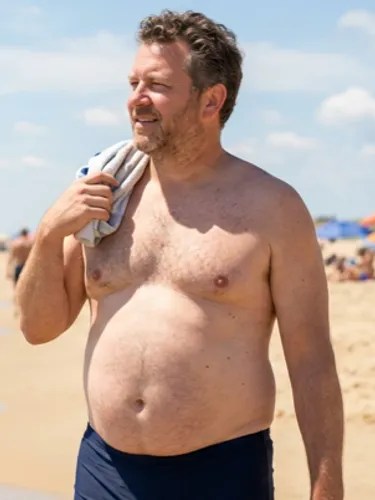

Example images are AI-generated illustrations of a possible outcome, not guarantees of results. Nothing here is medical advice — talk to your doctor before starting a diet or exercise program.
Leave a Reply