
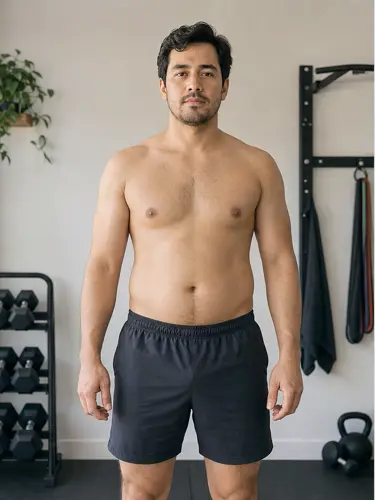

You can be a lean 14% body fat and still have a stomach that pooches out the second you stand up. People look at the protrusion, decide they need more cardio, and grind themselves into the ground chasing a fat-loss problem that isn’t a fat-loss problem at all. The shape of your abdomen has as much to do with the angle of your pelvis as it does with how much fat sits on top of it.
If your lower back arches more than it should and your belt line tilts forward, your abdominal wall has been physically pulled into a position where it can’t lie flat. The muscles are there. The leanness might be there. But the architecture is fighting you.
The mechanics behind a pooched stomach
Anterior pelvic tilt is what physical therapists call a rotational fault in the pelvis. The top of the pelvis rolls forward and downward, which exaggerates the curve of the lumbar spine and pushes the lower abdomen out in front of the hip points. The visual result is a stomach that protrudes regardless of what the scale says. The structural result is that the rectus abdominis and obliques are stuck at a mechanical disadvantage — they’re being stretched at one end and shortened at the other, and they can’t contract hard enough to flatten the wall.
The cause is rarely a single muscle. It’s a chain. The hip flexors at the front of the pelvis become short and overactive from hours of sitting. The glutes and hamstrings at the back become long and weak from never being asked to fire. The lumbar erectors join the party because the glutes have abandoned their post. Your abs, meanwhile, sit in a permanently lengthened position and lose the strength to pull the pelvis back toward neutral.
Why crunching harder makes it worse
This is where most people make a costly mistake. They feel the protrusion, assume their abs are weak, and pile on more crunches and sit-ups. Both of those movements recruit the hip flexors heavily. You’re feeding the exact muscle group that’s already pulling your pelvis into the wrong position. After a few weeks of dedicated ab work, you may feel stronger and look the same — or worse.
The fix has nothing to do with grinding through more reps. It involves three things working in the same direction at the same time: lengthening what’s tight, strengthening what’s weak, and retraining the abs in ways that don’t reinforce the dysfunction.
What actually moves the needle
Mobilize the hip flexors first. A half-kneeling hip flexor stretch, held for forty-five seconds per side with the back glute squeezed and the pelvis tucked under, opens up the iliopsoas without requiring you to twist into a yoga pretzel. Three rounds. Daily for two weeks if you’ve been sitting for a decade.
Wake up the glutes. Hip thrusts, glute bridges with a pause at the top, and single-leg Romanian deadlifts teach the back of the pelvis to do its job again. The cue that matters is the squeeze at the top — a hard, deliberate contraction that holds for two seconds. Without that, you’re just moving weight.
For the core, swap the crunch-heavy work for anti-extension movements. Dead bugs, hollow body holds, ab wheel rollouts, and Pallof presses train your abs to resist the pelvis being yanked forward — which is the exact pattern you’re trying to undo. These are harder than they look on paper, and they translate directly into a flatter resting stomach because the muscle is finally being asked to do its actual job.
Skip the hamstring stretches. Tight hamstrings in this picture are a symptom, not a cause. They’re being held long all day by the forward tilt; stretching them further only weakens the structure that’s trying to pull your pelvis back into place.
How long until you see a change
Posture work pays out in weeks, not months. Most people who commit to a daily ten-minute mobility and activation routine see a visible difference in their standing profile inside three weeks. The rectus abdominis sits closer to the body wall. The lower belly stops shelving over the belt. None of this requires losing a single pound.
The reason this works is mechanical, not metabolic. You aren’t burning fat off the abdomen — you’re moving the abdomen back into a position where your existing leanness can be seen.
What the video adds
Jeff Cavaliere’s breakdown walks through the full attack plan in physical-therapist detail, including the exact stretches and activation drills, the cues that make each one work, and the order in which to do them. He’s a licensed PT who served as head physical therapist for the New York Mets, so the rehab-level precision is real. If you’re going to commit ten minutes a day to fixing this, watching him demonstrate the corrections is the difference between doing the movement and doing it right.
If you’ve been chasing visible abs with diet and cardio alone and the lower stomach won’t cooperate, run a four-week posture experiment before you tighten the macros any further. You may find the abs were already there.
Leave a Reply