
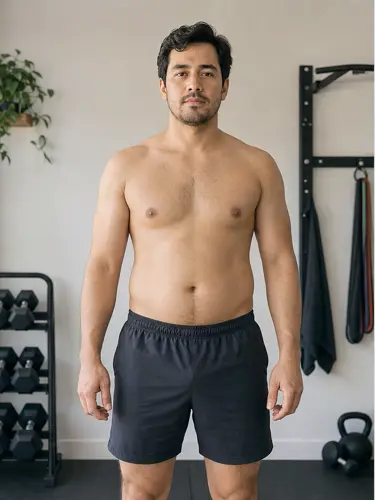

Most people trying to lose belly fat are training their abs the same way they did in gym class twenty years ago. Get on the floor, do some crunches, maybe hold a plank for thirty seconds, and call it an ab workout. There’s a reason that approach keeps failing: it treats the core as a single isolated muscle group when it was never designed to work that way.
The core is a stabilization system. Its entire evolutionary purpose is keeping you upright and balanced while the rest of your body moves. Which means the moment you lie down to train it, you’ve already removed the primary stress it’s built to handle. You’re not training your abs — you’re training a very specific spinal flexion movement that has almost nothing to do with how your midsection actually functions during real life or during high-calorie-burn exercise.
Standing Exercises Burn More Fat — Not Just More Calories
There’s an important distinction between general calorie expenditure and fat mobilization. When you do floor crunches, your heart rate barely moves. You might complete 50 reps and burn fewer calories than you would walking to the kitchen. But when you do standing ab movements — knee drives, rotational reaches, lateral steps with core bracing — you’re forcing the cardiovascular system to get involved. Heart rate goes up. Breathing rate goes up. You get what trainers call “cardio tone”: simultaneous fat-burning and muscle engagement in the same movement.
This matters because fat loss ultimately requires a caloric deficit. Exercises that keep your heart rate elevated for sustained periods contribute meaningfully to that deficit. Crunches don’t. A seven-minute standing ab circuit performed at the right intensity can do what forty minutes of floor ab work fails to accomplish, because one raises your metabolism and the other basically doesn’t.
The Afterburn Window Most People Leave on the Table
After any sufficiently intense workout, your body keeps burning calories above its normal resting rate for several hours. Exercise scientists call this excess post-exercise oxygen consumption — EPOC — but the practical implication is straightforward: a short, challenging session doesn’t end when the workout ends. The metabolic effect continues.
The length of that elevated burn depends on workout intensity. This is why a well-designed 7-minute session that pushes your heart rate into a moderate-to-high zone can trigger 10 or more hours of elevated calorie burn afterward. A slow, steady floor routine doesn’t produce the same effect regardless of how long you hold it. The stimulus has to be strong enough to force recovery — and crunches simply aren’t hard enough on the cardiovascular system to trigger that response.
Multi-Plane Movement Is Where Core Training Actually Lives
Your core has to resist and produce force in multiple directions: forward and back (sagittal), side to side (frontal), and rotational (transverse). Floor crunches only work the sagittal plane. Everything else — the obliques, the transverse abdominis, the deeper stabilizers that actually create the appearance of a tight midsection — gets almost no stimulus from traditional ab floor work.
Standing functional movements force all three planes simultaneously. When you do a split-stance knee drive with an arm reach overhead, you’re bracing against rotation, stabilizing lateral tilt, and controlling spinal extension all at the same time. That full-plane engagement is what builds the functional core strength that translates into a visibly flatter, more defined midsection. It’s also what trains the muscles responsible for natural posture and the “pulled-in” look that everyone is actually chasing when they do a hundred crunches in a row.
Why Challenge Formats Actually Work
One of the reasons 7-day challenge structures are so effective isn’t just the workout — it’s the commitment architecture. A seven-day window is short enough that most people can stay on track without the motivation erosion that hits around week three of a six-week program. You’re not asking for a lifestyle overhaul. You’re asking for seven days, which almost anyone can say yes to.
What often happens within that window: the habit loop forms. Seven consecutive days of doing the same workout at the same time creates a behavioral groove. By day five, you’re doing it because it’s automatic, not because you’re forcing yourself. That’s the actual goal of the seven-day format — to get past the deliberate-decision phase and into habit. The fitness benefit is real, but the behavioral scaffolding is what makes it stick.
One tactical addition that makes a major difference: measuring before and after. Waist circumference at the narrowest point, hip circumference at the widest — done on day one and day seven. That data point transforms the challenge from something subjective (“I think I look better?”) into something concrete. The numbers move faster than you’d expect in a focused week, and that early win creates the reinforcement that pushes you into the next week.
The Video Worth Following
Lucy Wyndham-Read’s second installment of her 7-Day Lose Belly Fat Challenge has accumulated over 14 million views — the kind of number that only happens when something actually works for a broad range of people. The workout runs seven minutes, requires no equipment, and demonstrates both a beginner and intermediate version of each exercise side by side so you can self-select based on where you’re starting. The follow-along format removes the need to think, which is exactly what you want when you’re building a daily habit.
Watch it below, measure yourself before you start, and check the numbers again on day seven.
Leave a Reply