
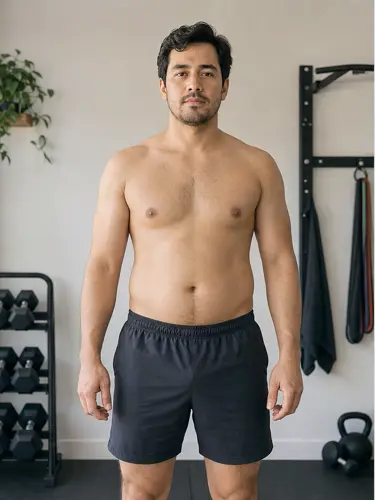

Most people train abs like they’re collecting stamps. A few sets of crunches here, some leg raises there, maybe a plank if they’re feeling ambitious. They pick exercises more or less at random and hope something eventually shows up. Then they wonder why, after months of consistent effort, the midsection still looks exactly the same.
The problem isn’t effort. It’s not even exercise selection, exactly. The issue is that most people have no organizing principle behind what they’re doing — no framework that ensures they’re actually training the entire muscular structure of their core. Fix that, and suddenly a handful of exercises becomes more than enough.
Movement Patterns, Not Exercise Lists
The most productive shift in ab training is moving from thinking about exercises to thinking about movements. Your abs — rectus abdominis, obliques, transverse — respond to two fundamental actions: moving the lower body toward the upper body, and moving the upper body toward the lower body. That’s it. Every ab exercise you’ve ever done falls into one of those two categories, or some combination of them.
The reason this matters is that these two movement patterns preferentially recruit different regions of the rectus abdominis. Bottom-up movements (where your pelvis and legs move toward your torso) place greater emphasis on the lower abdominal fibers. Top-down movements (where your torso and head move toward fixed legs) work the upper region more heavily. Neither pattern ignores the other zone entirely — the muscle is one continuous sheet — but the emphasis differs, and if you only train one direction, you’re leaving real development on the table.
The Obliques Are Not Optional
Here’s what most ab programs miss entirely: the obliques. These run diagonally across both sides of the torso, and visually, they do a lot of the work that makes a midsection look tapered and defined rather than just flat. But crunches and leg raises, performed straight up and down, barely touch them.
The fix is rotation. Add a twist at the top of any bottom-up or top-down movement, and you’ve engaged the obliques. This doesn’t require an entirely different exercise — it’s a modification. A standard reverse crunch becomes a corkscrew when you add a pelvic rotation at the top. A crunch becomes an upper circle crunch when you arc through one shoulder, lift, and continue rotating. The base movement patterns stay the same; the rotation is the layer on top that completes the picture.
Progressions Actually Matter Here
One thing that separates good ab training from mediocre ab training is the recognition that bodyweight exercises have genuine load variables. Most people treat leg raises as one exercise with one difficulty level. They’re not.
For bottom-up movements, the leverage changes dramatically based on knee angle. Knees bent = lighter load, shorter lever, easier. Knees extended = heavier load, longer lever, harder. Hanging from a bar = even harder, because now gravity is working against you through the entire range of motion rather than giving you a break at the top. This is a built-in progression system that costs nothing and requires no equipment beyond a pull-up bar.
For top-down movements, beginner versions focus on just clearing the shoulder blades from the floor. Intermediate versions involve adding rotation and reaching across the body. Advanced variations use cable stack resistance, which has the added advantage of being loadable — you can continue adding weight as you get stronger, unlike bodyweight crunches where there’s a ceiling.
The Sequencing Logic
There’s a practical reason to do bottom-up movements before top-down in a session. The legs are heavier than the torso in most exercises, which means bottom-up work is generally the more demanding pattern. Doing it fresh, while you have maximum muscular control, leads to better technique and more genuine abdominal recruitment. Top-down movements then finish the session, working effectively even when you’re slightly fatigued because the load (your torso) is comparatively lighter.
This isn’t a rigid rule, but it’s a useful default — especially if you’re also pairing ab work with heavier compound lifts and need to manage fatigue strategically.
Why Nutrition Runs the Show
None of this matters visually if body fat is high enough to obscure the muscles underneath. The abs are there — everyone has them — but whether they’re visible depends almost entirely on how much subcutaneous fat sits over them. Training the abs makes them thicker and more developed, which helps definition at lower body fat percentages, but no amount of ab work will push fat off that specific area. That’s spot reduction, and it doesn’t happen.
Fat loss is systemic. You reduce it across the body through a calorie deficit, and the midsection — often one of the last areas to clear up — eventually follows. Abs training and fat loss training are complementary, not the same thing. Running both simultaneously is the actual path to a visible six-pack.
The Video Worth Watching
Jeff Cavaliere of ATHLEAN-X breaks down exactly this framework — two movement patterns, rotation for obliques, and progressions for each level — in a way that’s worth seeing demonstrated. The visual of him drawing the movement arcs on a whiteboard makes the bottom-up vs. top-down distinction click faster than any description can. If you want to audit your current ab routine against a sound structural framework, this is 7 minutes well spent.
Once you understand these two patterns and how rotation plugs into both of them, you’ll never look at an ab exercise the same way again. The decision of which exercise to do becomes much simpler — you’re just picking vehicles for two movements, based on your current strength level and available equipment.
Leave a Reply