
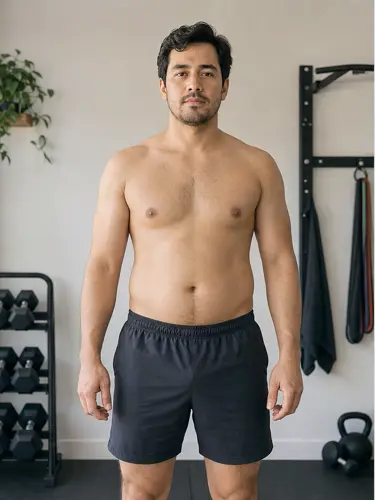
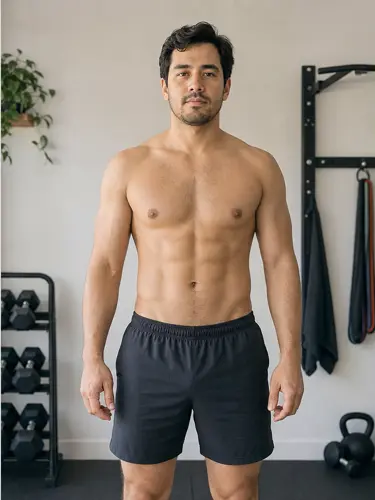
Do 500 crunches a week and your abs still look flat under a layer of fat you can’t seem to shift. Meanwhile someone at your gym who never touches a crunch machine has a core that looks carved and holds a plank for four minutes without shaking. The gap isn’t genetics. It’s that most people are training their abs for the wrong job.
The rectus abdominis — the muscle that makes the six-pack pattern — is built to flex your spine forward. Crunches and sit-ups hit that motion directly, which is exactly why they feel productive. But your abs spend almost none of their real-world time flexing your spine. Their actual job is resisting movement: keeping your torso rigid while you squat, deadlift, sprint, or just carry your kid on one hip without tipping sideways. Train for the wrong job long enough and you get a core that’s decent at crunching and mediocre at everything that actually matters, including how your midsection looks standing up straight under a shirt.
Bracing beats bending
Physical therapists who work with lifters talk about the core in terms of anti-movement: anti-extension, anti-rotation, anti-lateral-flexion. A dead bug trains anti-extension — keeping your lower back pinned to the floor while your limbs move independently. A Pallof press trains anti-rotation — resisting a cable trying to twist your torso. A suitcase carry trains anti-lateral-flexion — walking with a heavy weight in one hand while your spine stays vertical instead of caving toward the load.
None of these look like a “core workout” in the way a gym class does. There’s no burn, no crunch count, nothing to post. But they build the kind of stiffness that shows up as intra-abdominal pressure — the transverse abdominis and obliques cinching down like a natural weight belt every time you brace. That pressure is what separates someone who can squat heavy without their lower back rounding from someone who can’t, and it’s a far better predictor of a strong, flat-looking midsection than crunch volume ever was.
Where the plank actually goes wrong
Planks get treated as the correct alternative to crunches, and mechanically they are — but most people hold a plank with their hips sagging or their ribs flared up toward the ceiling, which turns a bracing exercise into a lower-back exercise. The fix isn’t holding it longer. It’s tucking the pelvis slightly, pulling the ribs down toward the hips, and squeezing glutes so the whole trunk locks into one rigid unit for 20 to 30 hard seconds. A well-braced 20-second plank trains more usable core strength than a sloppy two-minute one.
The same logic applies to loaded carries and anti-rotation work: quality of brace matters more than time under tension. If your form breaks down, the set is over, regardless of the clock.
Fat loss still runs the show
None of this replaces the deficit. Stability training builds the muscle and the bracing pattern; it doesn’t touch the layer sitting on top of it. You can have textbook anti-rotation strength and still not see a single ab if your body fat is sitting at 22%. The two tracks — build the core, lose the fat covering it — run in parallel, not in sequence, and skipping either one is why so many people train hard for months with nothing to show for it.
A weekly structure that covers both
Two to three short sessions a week is enough. Pick one anti-extension move (dead bug, ab wheel, or a braced plank variation), one anti-rotation move (Pallof press or a landmine rotation hold), and one carry (suitcase or farmer’s walk) for 20-40 seconds of tight bracing per set, three to four sets each. That’s a complete session in under 20 minutes, and it leaves you far less sore and far more functional than a crunch-heavy routine that hammers the same flexion pattern every session.
Squat University built a following by teaching lifters to fix movement problems at the source instead of chasing symptoms, and their approach to ab training follows the same logic — stop treating the six-pack as a muscle to isolate and start treating the whole trunk as a system to brace. Their full workout breakdown walks through the exact anti-extension and anti-rotation drills above with coaching cues on hip position and rib alignment that are hard to get right from text alone, which is worth watching if planks tend to show up in your lower back instead of your abs.
Swap two of your crunch sessions this week for a bracing-based session instead, and pay attention to how your lower back feels during your next heavy lift. That difference tends to convince people faster than any explanation does.
Leave a Reply