
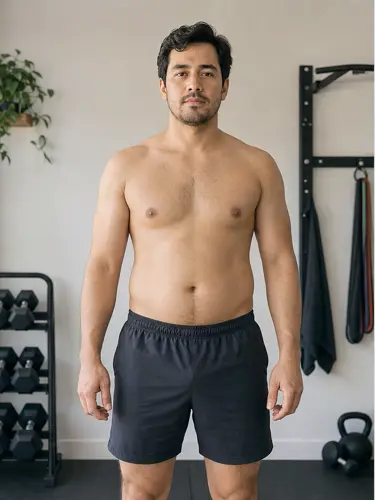

Most people who set out to lose belly fat do lose some weight. The problem isn’t getting started — it’s that the weight comes back. Dr. Layne Norton, who has spent much of his recent career studying long-term diet outcomes, puts it plainly: the relapse statistics are still pretty bad. More people regain the weight than keep it off, regardless of which diet they used.
That pattern has less to do with willpower or knowledge than most people assume. It has to do with getting the variables in the wrong order — and misunderstanding what “working hard” actually means in the context of fat loss.
The Priority Stack Most People Get Backwards
Most fat loss content treats cardio as the primary tool and diet as the supporting act. Exercise scientist Dr. Eric Helms lays out a different priority stack — one that changes the whole picture when you actually follow it in sequence.
First: an energy deficit. Without it, nothing else matters. Second: resistance training to preserve muscle while you lose fat, because this is what determines whether the weight you shed comes from fat or lean tissue. Third: setting the deficit at the right size — somewhere between 0.5 and 1.5 percent of bodyweight per week, not aggressive slashing. Fourth: protein high enough to protect that muscle (generally above 2g per kilogram of bodyweight). And fifth: an appropriate cardio volume that supports the deficit without undercutting your training recovery.
That fifth item is what most people lead with. It’s also the one with the least leverage when the others aren’t in place.
The Protein Target You’re Probably Missing
Standard nutrition guidance recommends around 0.8g of protein per kg of bodyweight. That number is calibrated for sedentary people at maintenance weight — not for someone in a caloric deficit trying to hold onto muscle while losing fat.
When you’re cutting, the research points toward above 2g per kg. For a 75kg person (roughly 165 lbs), that means at least 150 grams daily. If you have a significant amount of body fat to lose, a practical shortcut is to use your height in centimeters as your gram target — so 170cm becomes 170g of protein. It scales better with lean mass without wildly overestimating based on total bodyweight.
The payoff isn’t just muscle retention. Protein is the most satiating macronutrient by a wide margin. Hitting a high protein target makes staying in a deficit considerably less miserable, which matters far more than most people give it credit for when they’re six weeks into a cut and starting to hate everything.
Why Willpower Is the Wrong Tool
Sports nutritionist Sohee Lee makes a point that cuts through a lot of fitness culture messaging: people who lose fat and keep it off don’t have stronger willpower. They have better environments.
The habit formation research is consistent on this: self-control is useful when you’re building new behaviors, but it’s a terrible ongoing strategy. Your brain doesn’t maintain a diet through sustained conscious effort — it runs on defaults. And defaults are shaped by what’s visible, accessible, and easy.
What actually works is what Lee calls “designing for laziness.” If the food that supports your goals is visible and easy to grab, you eat it. If the food that works against those goals requires even a little friction — stored in an opaque container, pushed to the back of a shelf, kept in a different room — you eat it far less often. Not because you decided to resist it, but because the path of least resistance changed.
This isn’t motivational advice. It’s choice architecture, and it’s been replicated across dozens of controlled studies. A clear bowl of candy on your desk disappears faster than the same candy in a drawer two feet away. You didn’t develop more willpower between those two scenarios. The environment did the work.
What People Who Keep the Weight Off Actually Do
Getting lean is one challenge. Staying lean is a different and often harder one. Dr. Layne Norton has spent significant time researching the characteristics of people who successfully maintain weight loss long-term, and five patterns keep surfacing.
Some form of cognitive restraint — calorie counting, macro tracking, time-restricted eating, point systems. Not obsessive, but consistent. Regular self-monitoring — weighing themselves often enough to catch drift before it becomes a 20-pound problem. Not panicking over daily fluctuations, but treating weekly trends as a feedback signal. Regular exercise, which matters partly because consistent training appears to increase sensitivity to satiety signals, making it easier to regulate intake without tracking everything. Structured programs of some kind — people who “just try to eat well” with no plan perform worse on average than people using any organized system, even imperfect ones.
And the strongest predictor that showed up in recent research: low recency bias. Valuing long-term outcomes over short-term feelings. The people who keep weight off consistently prioritize what moves them toward their goal over what feels good in the moment. It’s not that they don’t want the thing in front of them. It’s that the long-term signal outweighs the immediate one more often — and that tends to be a practiced skill, not an innate trait.
A Note on Supplements
Dr. Eric Trexler, who has published extensively on performance supplements, is direct about fat burners: the ones that actually do something useful aren’t doing it by burning fat. Creatine helps you maintain training output during a cut. Whey protein helps you hit the protein targets that protect muscle. Fish oil fills an essential fatty acid gap that often opens up when you reduce total food intake. A multivitamin covers micronutrient shortfalls that get harder to prevent when you’re eating less.
Everything marketed as a thermogenic either has habituation issues (caffeine), quality control problems (yohimbine), or lacks the kind of strong evidence that would justify using it over something more boring and reliable. The supplements that work during fat loss are the ones that support the fundamentals, not the ones trying to shortcut them.
Watch the Full Breakdown
Jeff Nippard assembled five highly qualified experts for this video — Eric Helms, Cliff Wilson, Sohee Lee, Layne Norton, and Eric Trexler — covering fat loss from the physiology to the psychology to the long game of maintenance. Each one adds a layer the others don’t cover, and it’s worth watching in full rather than treating the highlights as the whole picture.
The through-line across all of them: getting lean doesn’t require a perfect diet or a perfect program. It requires getting the fundamentals in the right order, setting up an environment that makes the right choices easier by default, and thinking about the next six months instead of the next six days.
Leave a Reply