

Mobility and movement control
People differ in how comfortably they can move into a given position. A smaller range or an easier exercise can make practice more manageable.
Choosing a comfortable movement range
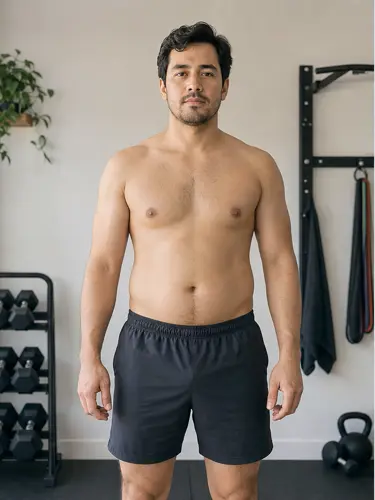
Your core is part of a closed kinetic chain. When your hips stay flexed from sitting all day, your pelvis tilts anteriorly—your stomach poaches forward, your abs flatten, and you look softer no matter your body fat. The same happens when your chest is tight and shoulders are internally rotated: your entire core alignment shifts. These aren’t exercise problems; they’re positioning problems. Stretching fixes the root cause.
Combining mobility and strength exercises
Here’s the physics: your muscles only work as well as the range of motion they control. A tight hip flexor means your anterior core chain (your rectus abdominis, obliques, and deep core) cannot work through full range. Lengthening that tissue first means every crunch, every leg raise, every plank activation becomes more effective because you’re now working muscles at their actual functional length. You get more contraction, more time under tension, and faster results.
Practicing controlled movement
Belly fat and core weakness aren’t your spine’s only enemies—immobility is. A spine locked in extension (tight hips, weak glutes) places constant shear load on your lumbar discs. A spine locked in flexion (rounded shoulders, tight hamstrings) does the same. Adding mobility work doesn’t just improve how your abs look; it removes the mechanical stress that ages your spine prematurely.
The Stretching + Strength Formula
The optimal approach isn’t stretching instead of core training—it’s stretching as the foundation. Spend 5-10 minutes on mobility work that targets your hip flexors, chest, shoulders, and hamstrings. Then do your ab training. This order matters. Tight muscles blunt every contraction; loose, mobile muscles express full potential. The video below walks through twelve stretches designed precisely for this purpose—each one targets a different link in the kinetic chain, so by the end you’ve restored mobility across your entire anterior and posterior core system.
Leave a Reply