
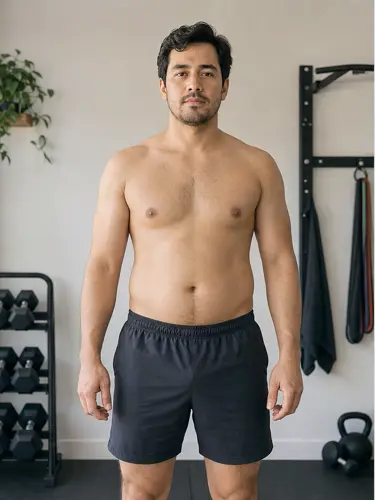
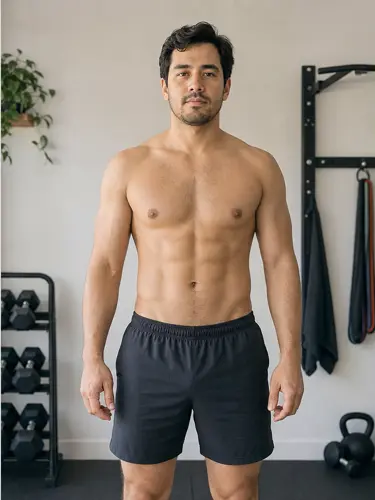
Short answer: you would look like a smaller, sharper version of yourself — not like the model on the supplement bottle. Getting abs does not give you a new frame, a new face, or shoulders you did not build. It removes the layer covering the muscle you already have. If you want to actually see it rather than imagine it, you can upload one photo to an AI transformation tool and get a realistic preview of your own lean body in about 30 seconds, or you can work it out on paper with the numbers below. This post does both.
Why your mental picture is almost always wrong
When most people picture themselves with abs, they picture a fitness model. That is a bad reference point for two reasons, and both of them matter if you want an honest answer.
First, the model has a different amount of muscle than you do. Abs become visible when body fat drops, but how they look when they arrive depends entirely on how thick the underlying muscle is. Two men can both be at 11% body fat and look completely different: one has deep, blocky separations, the other has a flat stomach with faint lines. Neither is doing anything wrong. That is muscle size, and it is built over years, not during a cut.
Second, people massively underestimate how much smaller they will be. Losing 30 pounds of fat does not just flatten your stomach. Your face changes. Your arms get less round. Your clothes hang differently. Most people imagine their current body with a six-pack pasted on, which is not a thing that exists.
What actually changes, in order
Fat comes off in a genetically determined order, and the stomach is usually near the end of the line for men. Here is the sequence most people experience, roughly:
- Face and neck first. This is why people start saying you look different long before your shirt fits differently.
- Arms and shoulders. Definition shows up here early because there is less fat covering them to begin with.
- Chest and upper back. The chest tightens and the shoulders start to look wider by comparison, even though nothing grew.
- Upper abs. The top two rows appear first, usually in good overhead light and after a workout.
- Lower abs and the V-cut. Last, and stubbornly so. This is the region that makes people quit two weeks early.
If you have ever thought “my abs are showing at the top but my lower belly is still soft,” you are not broken and you did not do the wrong exercise. You are simply not finished yet.
The numbers that tell you what to expect
Abs are a body fat number, so you can predict the outcome fairly well. For most men the first faint outline shows up around 15% body fat and a clear six-pack around 10–12%. For most women, that is roughly 22% for the first outline and 19–20% for clear definition, because women carry more essential fat by biology.
To turn that into a picture of yourself, work out your goal weight. Estimate your current body fat, subtract it from your weight to get your lean mass, then divide that lean mass by (1 minus your target body fat). A 195-pound man at 24% body fat is carrying about 148 pounds of lean mass. At 11% body fat he weighs about 167 pounds. That is what he will look like: himself, 28 pounds lighter, with the same skeleton and the same arms.
Our free “When will my abs show?” calculator runs that math for you and gives you a date, plus the goal weight and the pounds of fat between here and there.
Seeing it instead of calculating it
A goal weight is a number, and numbers are not very motivating. What actually keeps people going is a picture. This is the gap AI image tools have quietly closed in the last couple of years: you can now upload a photo of yourself and get back a realistic rendering of the same person, same face, same lighting, at a lower body fat.
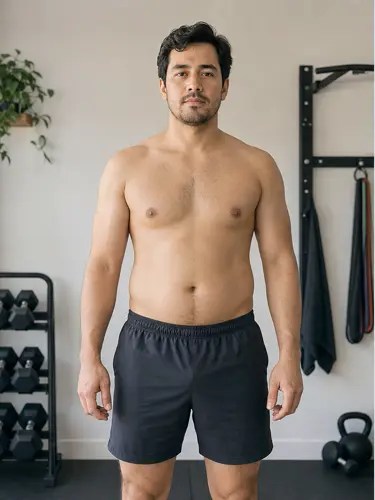
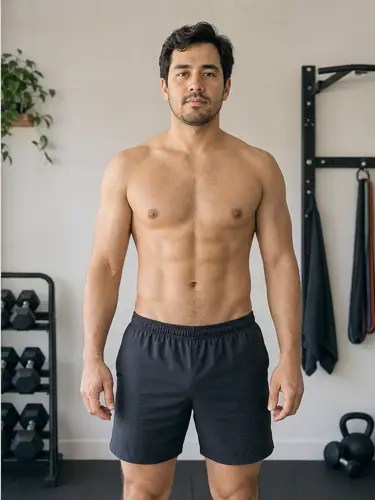
Two honest caveats. The image is an illustration of a plausible outcome, not a promise — no software knows how your particular body distributes fat or how much muscle is under there. And it does not do the work for you. What it does do is replace a vague fantasy with a specific target, which is a real advantage when you are eight weeks in and wondering whether any of it is working.
What to do with the answer
Once you know what you are aiming at, the plan is unglamorous and has not changed in decades: eat in a moderate calorie deficit, keep protein high enough to hold onto muscle (roughly 0.7–1 gram per pound of goal body weight), lift weights so there is something worth uncovering, and give it months rather than weeks. Direct ab work makes the muscle thicker, which helps it show sooner, but it will never out-run the layer on top of it.
The people who finish are almost never the ones with the best program. They are the ones who could still picture the destination in month four.
See your own version
Abs By AI takes one photo and shows you a realistic preview of yourself lean, in about 30 seconds. Three free tries, no credit card.
Example images are AI-generated illustrations of a possible outcome, not guarantees of results. Nothing here is medical advice — talk to your doctor before starting a diet or exercise program.
Leave a Reply