
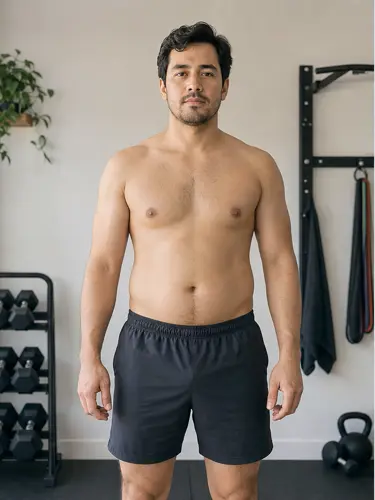
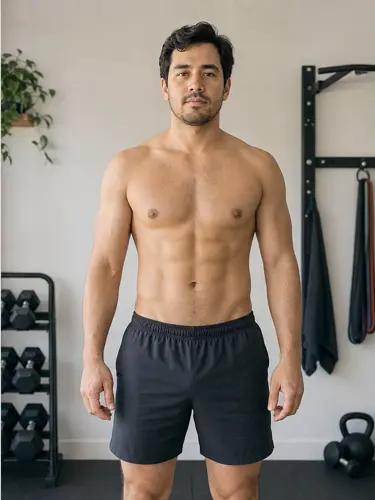
A filter adds or changes visual details in an existing photo. A generative model can also alter shape and texture. Both create a visual example and cannot tell you what your body will look like in the future.
What an abs filter does
Filters on social platforms and most “six pack photo editor” apps work by overlay. The app finds your torso, then draws a pre-made ab texture on top of it, shaded to fake depth. Some let you drag and warp the overlay to line it up.
The tell is always the same: it does not respect your body. The overlay does not know where your ribcage ends, so the abs sit too high or too low. It does not change your waist, so a soft midsection now has sharp cuts on a round silhouette — a combination that does not exist in nature and which the eye catches immediately. And it does not survive movement or a change of lighting.
None of that is a criticism. A filter is doing exactly what it was built to do, which is be funny for eight seconds. It just cannot answer the question “what would I look like?”, because it never looked at your body in the first place.
What an AI transformation does
A generative model does not paste anything. It regenerates the whole image with one property changed: how much fat you are carrying. Because it is redrawing rather than overlaying, the knock-on effects come along for free — the waist narrows, the shoulders read wider by comparison, the face gets leaner, the shadow under the ribs changes, and the shirt or waistband sits differently.
That is why the result can look like a real photograph, and it is also why it takes about 30 seconds rather than happening live in your camera. It is a different amount of computation by orders of magnitude.
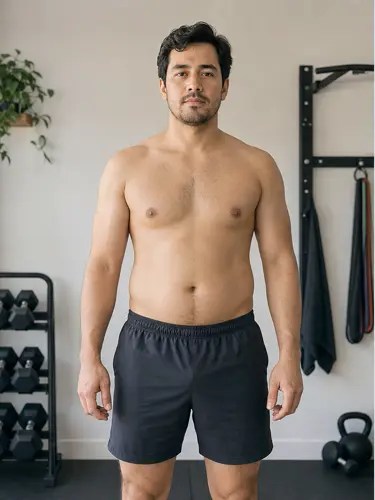
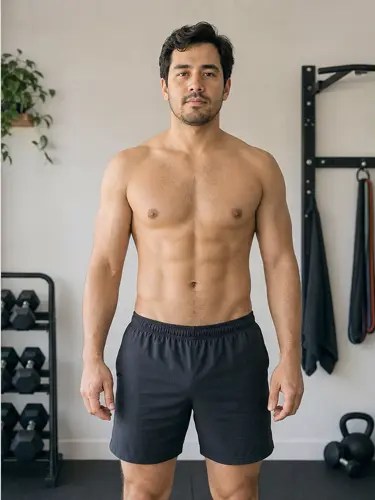
Notice the whole silhouette changed, not just the stomach. That is the difference in one picture.
Side by side
| Abs filter | AI transformation | |
|---|---|---|
| Method | Draws an overlay on top | Regenerates the image |
| Changes your waist | No | Yes |
| Speed | Instant, live | About 30 seconds |
| Looks real up close | No | Usually |
| Good for | Jokes, social video | Setting a goal you can see |
The honesty question
There is a reasonable objection here: is a realistic fake photo of your own body a healthy thing to look at?
Presentation matters. A generated image should be labeled as fictional and kept separate from a photograph documenting an actual change.
The practical test: does the tool label its output as AI-generated and as an illustration rather than a promise? If it does not, be sceptical of everything else it tells you.
A calculator or a date added to an AI image cannot make the image a forecast. Use training records and genuine progress photos for documenting changes. Explore the calculator.
Which should you use?
A filter and a generative tool change an image in different ways. Choose the format that suits your creative purpose, and label it clearly.
Abs By AI generates a fictional image from a reference photo and instructions. It does not measure a future body-fat percentage or physical result.
Example images are fictional AI illustrations, not guarantees of results. Nothing here is medical advice — talk to your doctor before starting a diet or exercise program.
Leave a Reply