Author: SixPackAbs.com

  • Four Hard Sets a Week Is Enough for Your Abs (The Research Is Clearer Than You Think)

    Most ab advice quietly assumes you have unlimited time. Three hundred crunches. A daily ten-minute burner. A twelve-move circuit you’re supposed to run through before bed, forever. And then real life shows up — a deadline, a sick kid, a week of travel — and the whole thing collapses because it was never built to survive a bad Tuesday.

    The research on training volume says something almost nobody repeats: the floor is far lower than the fitness industry lets on. Not “do nothing and hope.” A specific, small, hard dose that keeps working while everything else in your week falls apart.

    Four hard sets a week gets you most of the way

    When researchers pool the hypertrophy studies and compare weekly set counts, a pattern shows up that surprises people. Lifters doing just one to four sets per muscle per week captured roughly 64% of the muscle growth achieved by people doing ten or more sets. Bump that to five to nine sets and you’re at about 84%.

    Read that again with your abs in mind. Four hard weekly sets of loaded core work — two exercises, twice a week, done properly — buys you around two-thirds of what a maximalist ab program delivers. The last third costs you triple the time.

    Strength follows a similar curve. A 2017 meta-analysis covering nine studies found that about 81% of strength gains came from one to four sets per exercise per week. Heavy exposure matters more than accumulated tonnage. Your body needs the signal, not the volume of the paperwork.

    Two caveats. These numbers are averages, so some people land above and some below. And most of the underlying subjects were untrained or recreationally trained — if you’ve been lifting hard for a decade, your minimum is higher. It’s still nowhere near what you’ve been told.

    Junk volume is where ab training goes to die

    The reason so many people run high ab volume and see nothing is that most of it isn’t stimulating anything. A set of fifty bodyweight crunches ends because your hip flexors got bored, not because your rectus abdominis ran out of contractile capacity. You performed a lot of reps. You bought almost no adaptation.

    Your abs are skeletal muscle. They grow the same way your quads do — through mechanical tension applied close to failure, with load that increases over time. Which means the exercise selection changes completely once you decide to train them minimally:

    Weighted cable crunch — 8 to 12 reps, holding a weight you’d fail with by rep 14. Spinal flexion under real load, which is what the rectus abdominis is actually built to do.

    Hanging leg raise — full range, no swing, 6 to 12 reps. Add ankle weights or hold a dumbbell between your feet once bodyweight stops being hard.

    Ab wheel rollout — from the knees, then from the toes, then from a decline. The progression is built in and free.

    Weighted decline sit-up — plate held at the chest, then overhead as it gets easy.

    Pick two. Do two sets of each per week. That’s your four sets.

    Lower quantity has to mean higher intensity

    This is the trade the minimalist makes, and skipping it is how people conclude that low-volume training doesn’t work. If you’re only doing four sets, every one of them needs to end within a rep or two of failure — RPE 9 or 10. A set of cable crunches you stop because the counter hit twelve is a wasted set when you only have four.

    Drop sets extend this further without costing you time. Brad Schoenfeld’s work on hypertrophy points to drop sets as a way to add stimulating reps without adding session length. Take your cable crunch to failure, strip 30% of the weight, and go straight back to failure without resting. Those second-round reps arrive with the muscle already fatigued, which means they’re high-tension reps from the first one.

    Pair your core work with something that doesn’t compete

    Here’s a detail worth knowing about where gym time actually goes. Jeff Nippard once tracked a full push day and found he spent 14 minutes lifting and 56 minutes resting. Most lifters land somewhere near that ratio. The workout isn’t long because the work is long — it’s long because of the gaps.

    Supersets close those gaps, but only if you pair the right things. A 2020 study found that supersetting two exercises for the same muscle group degraded performance on the second exercise. Pair movements that don’t overlap and both stay intact: hanging leg raises with lateral raises, ab wheel rollouts with calf raises, cable crunches with face pulls. Your core rests while your delts work. Nothing is idle.

    Shortening rest periods works too, but not the way most people attempt it. Cutting from two minutes to sixty seconds overnight tanks your performance. Cut fifteen seconds per week instead and your cardiovascular recovery catches up as you go.

    Some weeks, maintenance is the goal

    There’s a study from Bickel and colleagues that deserves more attention than it gets. Subjects held onto their muscle mass for eight months while training at one-ninth of their previous volume. Building takes work. Keeping costs a fraction of that.

    So when you hit a week where four sets isn’t happening — newborn, deadline, hotel gym with a broken cable stack — one hard set of ab wheel rollouts on the carpet is not a token gesture. It’s a maintenance dose with research behind it. The month you spend at one set a week does not erase the year you spent at four.

    None of this changes the part everyone wishes it would: your abs become visible when your body fat drops, and that happens in the kitchen. Training them harder with less time won’t reveal them. It will make them thicker and more defined once they do show up, and it will keep you consistent long enough for the diet side to matter.

    Watch this next

    Jeff Nippard’s minimalist training video walks through the underlying research in more depth than a written summary can — the meta-analyses, the volume curves, and examples of elite bodybuilders like Dorian Yates and Jeff Alberts who built world-class physiques on four to eight sets per muscle per week. He also covers warm-up compression and exercise selection for time efficiency, which is where most people lose fifteen minutes they didn’t know they were spending.

    Worth the fourteen minutes if you’ve ever abandoned a program because it demanded more time than your life had available.

    Try the four-set version for six weeks before you decide it’s not enough. Track the weight on your cable crunch. If it’s going up, the program is working, however small it looks written down.

  • 10-Day Belly Fat Loss Challenge: The Proven Workout Formula That Actually Works

    10-Day Belly Fat Loss Challenge: The Proven Workout Formula That Actually Works

    You’ve probably seen the 10-day challenge videos on YouTube. Most are gimmicks. This one is different. The difference isn’t willpower or some magic ingredient—it’s the structure of the workouts themselves.

    A belly fat loss challenge doesn’t fail because you lack discipline. It fails because most programs don’t target the right variables. They treat all fat the same, ignore metabolic adaptation, and don’t account for visceral fat—the dangerous fat buried deep inside your abdomen that shows up on your waistline first and leaves last.

    Why 10 Days? The Science of Visible Change

    Ten days is the exact window where your nervous system adapts to a new stimulus, inflammation drops in your abdominal area, and water retention flattens out. Combined, these create visible progress. Not permanent transformation—but progress that motivates you to continue beyond day 10, which is where real change happens.

    The research is clear: visible results in the first 10 days predict completion rates. People who see a flatter stomach in week one are 4x more likely to reach week four, where actual fat loss compounds.

    The Structure That Separates Results From Excuses

    Effective belly fat workouts follow three rules that most programs miss:

    1. Target the deep core first. Your rectus abdominis (the six-pack) sits on top. Your transverse abdominis sits underneath and wraps around your entire torso. Train the deep layers first—they fire harder when you’re fresh—and the surface abs follow. This is backwards from crunches.

    2. Use standing movements. Lying abs work the muscle in isolation. Standing work requires stabilization from your feet through your core. This recruits more muscle fibers, burns more calories, and creates more metabolic demand. A 10-minute standing routine beats a 30-minute mat session on every metric.

    3. Vary intensity within each session. Belly fat loss accelerates under metabolic stress, not monotone effort. A 10-minute session mixing 30 seconds of intense work with 15 seconds of active recovery creates a 3-hour metabolic elevation. Steady-state doesn’t.

    Why This Challenge Sticks When Others Fail

    Most 10-day challenges ask you to do the same workout every day. That creates two problems: adaptation fatigue and boredom. This challenge structure varies the stimulus daily—some days heavy tension, some days speed work, some days endurance—so your body never plateaus and your brain never tunes out.

    The second failure point is nutrition advice. This challenge doesn’t hand you a restrictive diet. Instead, it focuses on what to add (protein, vegetables, water) rather than what to remove. This works because adding displaces—a full stomach of protein and fiber leaves less room for empty calories.

    What to Expect Day by Day

    Days 1–3: Your core wakes up. You’ll feel muscle soreness, which is water retention. Your waistline won’t visibly change, but your stomach will feel tighter during workouts.

    Days 4–7: The inflammation flattens. Combined with the muscle pump, your waistline will look visibly tighter, especially in the morning or after the workouts. This is when most people commit to extending beyond day 10.

    Days 8–10: The nervous system has adapted to the stimulus. Your capacity increases—you can do more work in the same time. This is momentum. This is where the real payoff begins, because you’re now training at higher intensity than you were day one, using less effort.

    The Biggest Mistake: Stopping at Day 10

    The challenge works because it’s time-bound. Everyone can commit to 10 days. But the moment day 11 hits, most people stop. This is the wrong move. The best strategy is: complete the 10 days, then extend for 10 more days (with one rest day inserted), then another 10. Three cycles = roughly 30 days of progressive training, and real fat loss compounds over that time window.

    Your first cycle is neural adaptation and water loss. Your second cycle is metabolic elevation. Your third cycle is where the actual fat starts disappearing at scale.

    The Video That Demonstrates the Difference

    The video below breaks down a complete 10-day challenge structure: which movements to prioritize, how to scale them if you’re a beginner, when to increase intensity, and what the progression should look like. It avoids the “do burpees until you hate yourself” trap and instead focuses on the variables that actually move belly fat: movement quality, metabolic stress, and consistency.

    The challenge isn’t a shortcut. It’s a trigger. It proves to yourself that change is possible, and then you build on that proof.

  • Abs Filters vs. AI Body Transformations: What Is the Difference?

    An abs filter overlays a fake six-pack on your video or photo in real time. An AI body transformation re-renders your actual body at a lower body fat. One is a joke you send to a group chat; the other is a picture of a goal you can genuinely reach. People search for both using the same words, get the wrong one, and conclude the whole category is a gimmick. It is worth ten minutes to know which is which.

    What an abs filter does

    Filters on social platforms and most “six pack photo editor” apps work by overlay. The app finds your torso, then draws a pre-made ab texture on top of it, shaded to fake depth. Some let you drag and warp the overlay to line it up.

    The tell is always the same: it does not respect your body. The overlay does not know where your ribcage ends, so the abs sit too high or too low. It does not change your waist, so a soft midsection now has sharp cuts on a round silhouette — a combination that does not exist in nature and which the eye catches immediately. And it does not survive movement or a change of lighting.

    None of that is a criticism. A filter is doing exactly what it was built to do, which is be funny for eight seconds. It just cannot answer the question “what would I look like?”, because it never looked at your body in the first place.

    What an AI transformation does

    A generative model does not paste anything. It regenerates the whole image with one property changed: how much fat you are carrying. Because it is redrawing rather than overlaying, the knock-on effects come along for free — the waist narrows, the shoulders read wider by comparison, the face gets leaner, the shadow under the ribs changes, and the shirt or waistband sits differently.

    That is why the result can look like a real photograph, and it is also why it takes about 30 seconds rather than happening live in your camera. It is a different amount of computation by orders of magnitude.

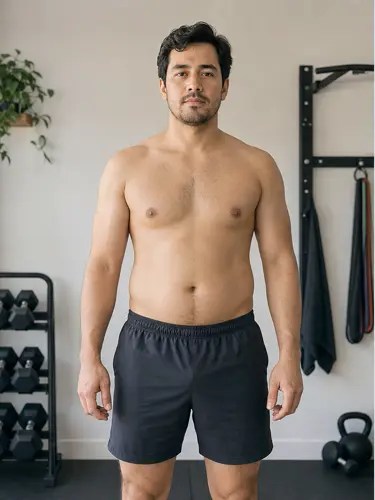
    A man before an AI body transformation
    BEFORE
    AI-generated example of the same man with a leaner midsection and visible abs
    AI-GENERATED EXAMPLE — not a real transformation

    Notice the whole silhouette changed, not just the stomach. That is the difference in one picture.

    Side by side

    Abs filterAI transformation
    MethodDraws an overlay on topRegenerates the image
    Changes your waistNoYes
    SpeedInstant, liveAbout 30 seconds
    Looks real up closeNoUsually
    Good forJokes, social videoSetting a goal you can see

    The honesty question

    There is a reasonable objection here: is a realistic fake photo of your own body a healthy thing to look at?

    It depends entirely on how it is framed. An image presented as “here is a body fat level you could plausibly reach, rendered on you” is a goal-setting tool, and it is more honest than the alternative most people use, which is a photo of a genetically unusual 24-year-old professional. An image presented as “this is what you will look like” is a lie, because no software knows your fat distribution, your muscle development, or whether you will actually stick to the plan.

    The practical test: does the tool label its output as AI-generated and as an illustration rather than a promise? If it does not, be sceptical of everything else it tells you.

    The second half of using one honestly is attaching a real timeline to it. A picture with no date is a fantasy. Run your numbers through the free abs timeline calculator and the picture becomes a target with a deadline, which is a completely different psychological object.

    Which should you use?

    If you want to make your friends laugh, the filter is free and already on your phone. If you want to see the actual body on the other side of six months of work, you want the transformation.

    Abs By AI does the second one: one photo, about 30 seconds, your face and skin tone preserved, adjustable intensity, every example clearly labelled. Three free tries, no credit card.

    Example images are AI-generated illustrations of a possible outcome, not guarantees of results. Nothing here is medical advice — talk to your doctor before starting a diet or exercise program.

  • Standing Pilates for Core Strength: Why 12 Minutes Beats a Hundred Crunches

    You’ve probably heard that crunches build abs. They don’t. In fact, most people who obsess over ab isolation exercises end up frustrated—they do hundreds of crunches and see almost nothing. The reason is mechanical: crunches move through only one plane of motion, they train the rectus abdominis in isolation, and they miss the deep core stabilizers that actually create visible, sculpted abs.

    The shift to standing core work changes this equation entirely. When you work your core from a standing position, your body stops cheating. You can’t brace ineffectively. You can’t use momentum. Gravity and stability demands mean your core has to engage fully, and the range of muscles activated expands dramatically.

    Why Standing Core Work Builds Better Abs Than Traditional Ab Isolation

    The core isn’t one muscle—it’s a system. Your rectus abdominis (the six-pack muscle) is just the front layer. Beneath it sits the transverse abdominis, the deepest stabilizer. On the sides sit the obliques. When you do crunches lying down, you activate maybe 40% of that system. Standing exercises demand the whole thing.

    Standing pilates specifically uses controlled breathing, precise positioning, and isometric holds to recruit fibers that floor exercises miss. When you’re upright, your core has to resist gravity in multiple planes simultaneously. Your posture, your spine stability, and your entire postural chain get trained. That’s not a bonus—that’s the point. Strong posture alone makes abs visible, even before you drop body fat.

    Research on core training consistently shows that exercises emphasizing core bracing and stability produce better real-world outcomes than movements emphasizing range of motion. If your core’s job is to stabilize your spine during daily movement, training it to stabilize makes far more sense than training it to crunch.

    The 12-Minute Protocol That Works

    Most people fail at core training because they treat it as optional—a 2-minute afterthought at the end of their workout. The research says that’s exactly backwards. Dedicated core work, done consistently, drives results faster than sporadic training squeezed in whenever you remember.

    Twelve minutes is the sweet spot. It’s enough time to work your core through multiple planes of motion, challenge your stability in different positions, and create a training stimulus without burning out. Done daily, or five to six times per week, this amount of targeted work outpaces the hour-long, low-intensity routines most people default to. The key difference is intensity and intent. Every rep matters because the range is limited and the movement is precise.

    The combination of standing work and pilates breathing creates another advantage: you’re building endurance in your core’s stabilizing muscles, not just size. Endurance keeps your posture upright all day. Endurance is what prevents your lower back from aching when you sit. Endurance is what makes abs look sculpted when you’re lean.

    What to Expect From This Approach

    If you’re coming from traditional ab circuits—endless crunches, cable crunches, machine work—switching to standing pilates core work will feel strange at first. It feels easier because you’re not exhausting a single muscle group. What’s actually happening is you’re distributing load across a larger system, so no one muscle screams, but everything is working.

    That distributed effort is why it works. Your core gets stronger without the postural breakdown that traditional ab isolation sometimes creates. Your posture improves. Your lower back stops hurting. And after four to six weeks of consistent work, the visual definition improves noticeably because strong core muscles actually look like something when you’re lean.

    If you’re already lean, standing core work tightens and defines your midsection faster than you’d expect. If you’re still carrying body fat, the work here is prerequisite work—get your core strong and stable first, then cut.

  • AI Body Transformation Apps: How They Work and What to Look For

    An AI body transformation app takes a photo of you and re-renders it at a lower body fat, keeping your face, pose, lighting and background intact. The good ones produce something you would believe is a real photo of you six months from now. The bad ones paste a stock six-pack onto your torso and hope you do not look closely. The difference is worth understanding before you upload anything, so here is what is actually going on and what separates the two.

    What the technology is actually doing

    These tools are built on image-editing models — the same family of AI that can change the season in a landscape photo or swap the colour of a car. You give the model your photo plus a written instruction describing the change, and it regenerates the image with that change applied while trying to preserve everything you did not ask to change.

    That last part is the hard bit, and it is where most of the engineering effort goes. A model asked to make someone leaner will happily also make them younger, taller, tanner, and give them a slightly different nose, because all of those things co-occur with “fitness photo” in its training data. Getting a result that is unmistakably you, only leaner, means constraining the model hard on identity, skin tone, pose, clothing and lighting — and then checking the output to confirm it actually complied.

    The four ways these tools fail

    If you try a few of them, you will run into all four of these. They are worth naming because they are the checklist for judging any result you get.

    • The face drifts. The body looks great and the person in the photo is a stranger. This is the most common failure and the most disqualifying — the entire point is seeing yourself.
    • It overshoots into bodybuilder. You asked to see yourself lean and got back someone with 40 extra pounds of muscle, comic-book shoulders and visible veins. Not motivating, just silly.
    • Nothing changes. The opposite problem. Models tend to hedge on heavier starting photos, returning something almost identical to the input. If you cannot tell the before from the after, the tool failed.
    • It adds a tan and an airbrush. Suddenly you are three shades darker with oiled, poreless skin. This reads as fake instantly and quietly changes your skin tone, which is its own problem.

    What to look for in a good one

    Identity preservation above everything. Put your own photo in and check the face first, before you look at the abs. If it is not you, nothing else matters.

    Intensity control. “Slightly leaner” and “as lean as I could realistically get” are different pictures and you should be able to ask for either. A tool with one setting is guessing at what you want.

    Honest labelling. Any result should be presented as an illustration of a possible outcome, not as a prediction or a promise. A tool that implies the image is what you will look like is overselling something no software can know — it has no idea how your body distributes fat or how much muscle is under the layer.

    Clear terms on your photo. You are uploading a shirtless picture of yourself. Read what happens to it. Whether it is stored, for how long, and whether you can delete it are reasonable things to know before you tap upload.

    A free try. There is no reason to pay before seeing one result on your own photo. The failure modes above are obvious in a single generation.

    Is any of this actually useful, or is it a toy?

    Fair question. The image does not burn a single calorie, and anyone selling it as a shortcut is lying to you.

    What it does is solve a real motivation problem. Fat loss takes months, and the feedback during those months is terrible — the scale moves in noisy increments, and you see yourself in the mirror every day, which is exactly the interval at which change is invisible. Having a concrete, personal image of the destination is the difference between an abstract goal and something you can actually picture in month four when adherence usually collapses. Setting it as a phone wallpaper is a genuinely common use, and it is not a stupid one.

    Photo of a man before an AI body transformation preview
    BEFORE
    AI-generated example of the same man rendered with visible abs
    AI-GENERATED EXAMPLE — not a real transformation

    Pair it with a real timeline and it gets more useful still. Our free abs calculator tells you roughly when you would arrive at the body in the picture, which turns a nice image into an actual plan.

    Try it on your own photo

    Abs By AI is built specifically around the failure modes above — identity locked, skin tone preserved, adjustable intensity, and every example clearly labelled as AI-generated. One photo, about 30 seconds, three free tries, no credit card.

    Example images are AI-generated illustrations of a possible outcome, not guarantees of results. Nothing here is medical advice — talk to your doctor before starting a diet or exercise program.

  • What Would I Look Like With Muscles? An Honest Answer

    You would look like yourself with wider shoulders, a fuller chest and thicker arms — noticeably better, but far less different than the picture in your head. Muscle is dense, so it takes up much less room than people expect: twenty pounds of it spread across your whole body is a real change and still nothing like the physiques used to sell it. And here is the part almost nobody says out loud — for most people, getting lean changes how muscular they look faster than getting bigger does. Below is what is actually achievable, what it looks like, and how to see your own version rather than guess at it.

    How much muscle you can actually add

    Muscle growth is fast at first and then slows down permanently. The widely used rule of thumb for a man training seriously and eating enough looks roughly like this:

    Training yearMenWomen
    Year 1~20–25 lb~10–12 lb
    Year 2~10–12 lb~5–6 lb
    Year 3~5–6 lb~2–3 lb
    Year 4 and beyond~2–3 lb~1–2 lb

    Two honest notes on that table. It assumes hard, consistent, progressive training and enough food and protein — it is a ceiling, not a schedule. And a well-trained natural lifter has added most of what they will ever add within about four or five years. That is not discouraging; it is why the guy who has been lifting for six years looks the way he does and you cannot buy a shortcut to it.

    If you are returning after a layoff, ignore the table. Regaining muscle you previously built happens far faster than building it the first time, sometimes in a couple of months.

    What that actually looks like on a body

    Muscle is roughly 15–20% denser than fat, which means a pound of it is visibly smaller than a pound of fat. This is the single most misunderstood fact in the whole conversation, and it cuts both ways.

    • 10 pounds of muscle. Your first year, or a solid comeback. Shoulders look rounder in a t-shirt, arms fill the sleeve, the upper chest stops sloping. People say you look like you have been working out. Nobody says you look big.
    • 20 pounds of muscle. Two to three years in. Clothes stop fitting. There is a visible V from shoulders to waist even in a shirt, and shirtless you read as athletic rather than skinny or soft. This is the level most people are actually picturing when they say “muscular.”
    • 30 to 40 pounds of muscle. Four to six years of consistent training. This is a genuinely impressive natural physique — the one people assume takes drugs. It does not, but it does take that long.

    Notice how long those timelines are compared to fat loss. Twenty pounds of fat can come off in five months. Twenty pounds of muscle takes two or three years. That asymmetry is the whole reason for the next section.

    Leaner beats bigger, at least at first

    If your question is really “how do I look more muscular,” the fastest answer for most people is not to add muscle. It is to remove the fat covering the muscle you already have.

    Muscularity is read by the eye as separation and shape, not volume. Fat smooths everything over: it fills the line between the deltoid and the bicep, rounds off the edge of the chest, and blurs the taper at the waist. Drop ten or fifteen pounds of fat and every one of those edges reappears — on muscle you built years ago. That is why people come back from a cut and get asked what they have been lifting, despite having lifted nothing new.

    The waist is the multiplier. Shoulder width is mostly bone and slow to change; waist size is fat and changes quickly. Shrinking your waist by three inches does more for how broad you look than a year of shoulder training, because what the eye actually measures is the ratio.

    So the honest sequencing for most people carrying extra weight is: lose the fat first, then build. You will look better sooner, you will find out how much muscle you already have, and you will not spend a year adding size under a layer nobody can see. Our post on how long it takes to get visible abs covers what that first phase actually looks like, and the free abs timeline calculator will give you a date for it.

    Why the picture in your head is misleading

    The reference images most people carry around are not honest comparisons, for four boring reasons.

    • Lighting. Overhead light creates the shadows that make muscle read. The same body under flat bathroom light looks half as defined. This is not a trick; it is why the gym mirror lies in both directions.
    • The pump. Photos are taken after training, when the muscle is temporarily fuller. It is real and it is temporary.
    • Peak week. Fitness photography frequently catches someone at the leanest and most dehydrated point of a months-long preparation. They do not look like that in June.
    • Drugs, sometimes. Not always, and it is unknowable from a photo — but the top end of what is shown online is not always a natural ceiling, and comparing yourself to it is a losing game.

    None of that means the goal is fake. It means you need a reference point that is actually you, at a body composition you can reach, rather than a stranger at their best hour of the year.

    See your own version

    This is the gap AI image tools have closed. Instead of imagining it, you can upload one photo and get back a realistic rendering of the same person — your face, your frame, your skin tone — leaner and more defined. It takes about 30 seconds.

    A man before an AI body transformation preview
    BEFORE
    An AI-generated example showing the same man leaner and more muscular
    AI-GENERATED EXAMPLE — not a real transformation

    Two caveats, the same two we give every time. The image is an illustration of a plausible outcome, not a promise — no software knows how much muscle is under there or how your body distributes fat. And it does not do the work. What it does is replace a borrowed fantasy with a specific, personal target, which turns out to matter a great deal in month four.

    Abs By AI takes one photo and shows you a realistic preview of yourself leaner and more defined, with the intensity dialled where you want it. Three free tries, no credit card.

    Example images are AI-generated illustrations of a possible outcome, not guarantees of results. Muscle-gain rates are general estimates and vary widely between individuals. Nothing here is medical advice — talk to your doctor before starting a diet or exercise program.

  • How Long Does It Take to Get Visible Abs? (An Honest Timeline)

    For most people the honest answer is three to nine months, and the date is decided almost entirely by how much fat you are carrying right now — not by how hard you train your abs. A man starting at 20% body fat is roughly five months from a clear six-pack at a sane rate of loss. A man at 30% is closer to nine. Ab exercises barely move that date. What moves it is the size of your calorie deficit and how many weeks you actually hold it. Below is the arithmetic, a timeline table by starting point, and a free calculator that will turn your own numbers into a calendar date.

    Why the date is mostly decided already

    You already have abs. Everyone does — the rectus abdominis is a muscle you use to sit up, and it is there whether you can see it or not. Visible abs are not a training achievement, they are a body fat number. The muscle becomes visible when the layer of fat over it gets thin enough for the shadow between the segments to read.

    That means the timeline is a subtraction problem. For most men the first faint outline shows up around 15% body fat and a clear six-pack around 10–12%. For most women that is roughly 22% and 19–20%. We go through why those numbers move for different people in our post on the body fat percentage you need to see abs.

    The other half of the equation is how fast fat can safely come off. A useful ceiling is about 1% of your body weight per week. Go faster than that for long and you start giving back muscle, which is self-defeating: less muscle under the fat means you have to get leaner to look the same. In practice most people should plan around half a pound to one and a half pounds a week.

    The arithmetic, done once

    Three steps, and you can do them on your phone.

    1. Find your lean mass. Weight times (1 minus your body fat). This is the part of you that is not fat, and the goal is to keep all of it.
    2. Find your goal weight. Lean mass divided by (1 minus your target body fat).
    3. Subtract, then divide by your weekly rate. That is your number of weeks.

    Worked example. A 200-pound man at 25% body fat is carrying 150 pounds of lean mass. To reach 12% he would weigh about 170 pounds, so he has roughly 30 pounds of fat to lose. At one pound a week that is 30 weeks — about seven months. His first faint outline arrives earlier, at 15% and around 176 pounds, which is 24 pounds and roughly 24 weeks. So the honest framing is: something visible around month six, the actual six-pack around month seven or eight.

    Our free “When will my abs show?” calculator runs all of that from a tape measure or a rough estimate, and gives you two calendar dates — one for the first outline, one for a clear six-pack — plus your goal weight and the pounds between here and there.

    Realistic timelines by starting point

    These assume a steady one pound per week and that you hold onto your muscle. Men are shown to 12%, women to 19%.

    Starting body fatFat to loseTime to a clear six-pack
    Man, 180 lb, 18%~12 lb~3 months
    Man, 180 lb, 22%~21 lb~5 months
    Man, 180 lb, 26%~29 lb~7 months
    Man, 180 lb, 30%~37 lb~8–9 months
    Woman, 150 lb, 25%~11 lb~3 months
    Woman, 150 lb, 30%~20 lb~5 months
    Woman, 150 lb, 35%~30 lb~7 months
    Woman, 150 lb, 40%~39 lb~9 months

    Two things stand out. First, nobody in that table is four weeks away, which is what most of the internet implies. Second, the range is enormous — three months and nine months are both normal answers, and which one you get has nothing to do with effort.

    Why it usually takes longer than the table

    The deficit you held is not the deficit you planned. This is the big one, and it is not a willpower lecture — it is arithmetic. Five disciplined days and two loose weekend days will often average out to no deficit at all. A person who thinks they are running 500 calories under and is actually running 200 under has not failed; they have quietly tripled their timeline.

    Your abs may be thin. Visible abs are a relief map. If the muscle underneath has never been trained with resistance, there is less to see, and you will need to go a few points leaner than the table suggests before anything reads.

    Fat leaves in a genetic order, and the stomach is usually last. Your face, arms and chest will look lean well before your lower abdomen does. This is the stage where most people quit, roughly two months from the finish, because the mirror stopped changing in the one place they are watching.

    Diet breaks are normal and they extend the calendar. Almost nobody runs a nine-month deficit without a maintenance phase or two. That is a sensible thing to do — just add the weeks to the estimate instead of pretending they did not happen.

    What actually shortens it

    • A deficit you can measure. Track for two weeks, watch the scale trend, adjust. The point is not to log food forever; it is to find out what your actual maintenance is once, so you stop guessing.
    • Protein around 0.7–1 gram per pound of goal body weight. This is the single highest-leverage change for keeping muscle while the fat comes off.
    • Lift weights. Not for fat loss — for making sure there is something worth uncovering, and for protecting the lean mass in step one of the arithmetic.
    • Direct ab work, for the right reason. Weighted ab training thickens the muscle, which makes it show at a higher body fat. It burns a negligible number of calories. Do it to raise the threshold, not to lose the fat.
    • Daily steps. Unglamorous, but it is the easiest lever to pull that does not make you hungrier.

    Things that do not shorten it: fat burners, waist trainers, ab belts, doing 300 crunches, and any product sold with a photo of someone who was already lean. You cannot spot-reduce, and nothing you buy changes the subtraction problem.

    Get your own date

    A generic answer is interesting. Your answer is useful. Run your weight and a tape measure through the free abs timeline calculator and you will get an actual date instead of a range.

    And see what you are aiming at

    A date on a calendar and a goal weight are still abstractions. The thing that keeps people going in month five is a picture. Abs By AI takes one photo and renders a realistic preview of you at a lower body fat — same face, same frame — in about 30 seconds. If you want to think about it first, our post on what you would actually look like with abs covers what really changes.

    An AI-generated example of a lean male physique with visible abs
    AI-GENERATED EXAMPLE — not a real transformation

    Example images are AI-generated illustrations of a possible outcome, not guarantees of results. Timelines here are general estimates, not medical advice — talk to your doctor before starting a diet or exercise program.

  • Six Minutes Daily Beats Hours of Cardio—The Pilates Proof for Belly Fat

    You’ve heard it a thousand times: “I don’t have time for a workout.” But what if the limiting factor wasn’t time at all? What if it was the wrong type of movement?

    Most people think belly fat responds to abdominal crunches and long cardio sessions. In reality, the fastest visual changes come from movements that engage your entire core, create metabolic demand, and actually train the deep stabilizer muscles that give your midsection shape.

    Why Pilates Actually Works for Belly Fat

    Pilates isn’t a trendy fitness gimmick—it’s a system built on controlled movement patterns that force your deep abdominal muscles to work constantly. Unlike a crunch, which is a brief explosive movement, Pilates exercises maintain tension throughout the entire range of motion. This sustained engagement does three things your typical ab workout misses.

    First, it teaches your core to stabilize under load. Your rectus abdominis (the six-pack muscle) gets attention, but your transverse abdominis—the deepest layer—is what actually pulls your stomach inward and creates the visible flat appearance. Pilates trains this intentionally. When your deep core is strong, your posture improves automatically, and better posture alone makes your abs look more defined.

    Second, Pilates workouts spike your heart rate without the impact of running. A 6-minute intense Pilates routine can create a metabolic demand similar to 20 minutes of moderate cardio, but with far less wear on your knees and joints. Your body has to expend energy during the workout and continues burning calories during recovery—the metabolic echo that makes short, intense workouts so effective for fat loss.

    Third, Pilates forces precision. You can’t phone it in on a Pilates reformer or a mat routine the way you might coast through a set of crunches. Each movement demands your attention, which means higher muscle recruitment and less wasted effort. That precision is what separates people who “do workouts” from people who actually get results.

    The 14-Day Challenge Structure

    Consistency beats intensity in real life. A 6-minute workout you do every single day will outperform an hour-long session you do sporadically. The 14-day structure works because it’s short enough to protect against burnout but long enough to build the neural adaptations that make movement feel easier. By day 14, your nervous system has learned the movement patterns, your core has grown stronger, and you’ve built the habit that makes the next 14 days automatic.

    The other advantage: short daily workouts prevent soreness from interfering with daily life. You’re not walking around unable to sit down or struggling to get out of bed. Instead, you’re accumulating work in small, manageable doses—and the cumulative effect on body composition outweighs the single aggressive session most people attempt once and then abandon.

    Why Deep Core Strength Changes How Your Abs Look

    A lot of people have abs under the fat but they can’t see them because their core isn’t strong enough to pull the stomach in. When your deep core is weak, your abdominal wall protrudes slightly, even at low body fat levels. The reverse is also true: when your transverse abdominis is strong enough to maintain tension throughout the day, your stomach naturally pulls inward. Pilates directly targets this, which is why people often see visible changes in midsection appearance after just a few weeks—sometimes before significant weight changes occur.

    Why You Should Prioritize This Over More Cardio

    Adding another 30 minutes to your treadmill time won’t accelerate belly fat loss if your core isn’t strong. Your body will simply adapt to the cardio and plateau. But adding targeted core work that you’ve never done before? That’s a genuine stimulus that forces adaptation. Pilates provides both the core strength training and the cardiovascular demand in one efficient package.

    Lilly Sabri’s 6-minute Pilates workout is exactly this type of work. She’s a chartered physiotherapist, which matters—her routines are built on proper biomechanics and core engagement principles, not just movement fads. The video walks you through each position, showing you how to feel the right muscles working and how to breathe through the hard parts. Watch it, complete the challenge, and notice what changes in your posture and midsection appearance after two weeks of daily practice.

  • What Body Fat Percentage Do You Need to See Abs? (Men and Women)

    For most men, abs start to outline around 15% body fat and become a clear six-pack around 10–12%. For most women, that is roughly 22% and 19–20%. Those numbers are reliable enough to plan around, but they are averages, and the gap between two people at the same body fat can be large. This post explains what moves the number for you specifically, and how to measure where you are without paying for a scan.

    The thresholds

    Body fatMenWomen
    No definition at all20%+28%+
    Flat, faint outline in good light15–18%22–25%
    Visible six-pack most of the time10–12%19–20%
    Deeply etched, veins, stage-lean6–8%14–16%

    The male and female columns are about three to eight points apart at every row, and that gap is not a fitness gap. Women carry more essential fat — the fat the body requires to function, stored in part around the breasts, hips and thighs. Essential fat is roughly 3–5% of body weight for men and 10–13% for women. A woman at 19% is doing the same thing physiologically that a man at 11% is doing.

    That bottom row is worth a warning. Stage-lean is not a lifestyle. Competitors hold it for a weekend, not a year, and holding it long-term tends to cost people sleep, mood, sex drive and, for women, menstrual regularity. If your goal is to look good with your shirt off, the third row is the target, not the fourth.

    Why two people at 12% look different

    Three things move your personal threshold, and none of them are under your control in the short term.

    How big your abdominal muscles are. Visible abs are a relief map: the muscle has to stick up far enough for the shadow between the segments to read. Someone who has trained abs directly for years will show a six-pack several points of body fat earlier than someone who has never done a weighted ab exercise. This is the single biggest reason people arrive at their goal body fat disappointed — they got lean, but there was not much underneath.

    Where you store fat. Fat distribution is genetic. Some people carry it evenly and lean out uniformly. Others hold it almost entirely in the lower abdomen, which means their arms, chest and face can look shredded while the stomach still looks soft. If that is you, you will need to go a few points leaner than the table suggests, and there is nothing you can do to change the order.

    How many segments you have. The rectus abdominis is divided by connective tissue into segments, and the number and symmetry of those divisions is inherited. Some people have four, some have eight, some have a visible offset where one side sits higher. No amount of training changes it. A “four-pack” at 9% body fat is not an unfinished six-pack.

    How to measure where you actually are

    Every method has error. What matters is picking one and using it consistently, because the trend is more useful than the absolute number.

    • Tape measure (U.S. Navy method) — free, about 3–4 points of error. You need waist, neck, height, and hips for women. This is the best value option and the one our calculator uses.
    • Smart scale — cheap, unreliable in absolute terms. Bioelectrical impedance is heavily affected by hydration, so the reading can swing several points between morning and evening. Useful for trend only, and only if you weigh at the same time under the same conditions.
    • Calipers — cheap and accurate in trained hands, poor in untrained ones. Measuring your own back and thigh sites is genuinely difficult.
    • DEXA scan — about $50–150, the practical gold standard. Worth doing once for a real baseline if the number matters to you. Not worth doing monthly.

    Whichever you choose, do not switch methods mid-diet and then panic. A caliper reading of 18% and a smart scale reading of 24% on the same body on the same day is entirely normal.

    Turning your number into a plan

    Once you know roughly where you stand, the arithmetic is simple. Your lean mass is your weight times (100% minus your body fat). Assume you keep that lean mass — which is the whole reason to lift and eat enough protein while dieting — and your goal weight is your lean mass divided by (1 minus your target body fat).

    A 160-pound woman at 33% body fat carries about 107 pounds of lean mass. At 19% she would weigh about 132 pounds. At one pound a week, that is around seven months. Our free abs timeline calculator does this in about ten seconds and gives you an actual calendar date.

    Or see the target instead of computing it

    A body fat percentage is an abstraction. If you would rather see what your own body looks like at the threshold, Abs By AI takes one photo and renders a realistic preview in about 30 seconds — same face, same frame, lower body fat. Three free tries, no credit card.

    An AI-generated example of a lean male physique with visible abs
    AI-GENERATED EXAMPLE — not a real transformation

    Example images are AI-generated illustrations of a possible outcome, not guarantees of results. Body fat thresholds are general guidance, not medical advice — talk to your doctor before starting a diet or exercise program.

  • What Would I Look Like With Abs? Here Is How to Actually Find Out

    Short answer: you would look like a smaller, sharper version of yourself — not like the model on the supplement bottle. Getting abs does not give you a new frame, a new face, or shoulders you did not build. It removes the layer covering the muscle you already have. If you want to actually see it rather than imagine it, you can upload one photo to an AI transformation tool and get a realistic preview of your own lean body in about 30 seconds, or you can work it out on paper with the numbers below. This post does both.

    Why your mental picture is almost always wrong

    When most people picture themselves with abs, they picture a fitness model. That is a bad reference point for two reasons, and both of them matter if you want an honest answer.

    First, the model has a different amount of muscle than you do. Abs become visible when body fat drops, but how they look when they arrive depends entirely on how thick the underlying muscle is. Two men can both be at 11% body fat and look completely different: one has deep, blocky separations, the other has a flat stomach with faint lines. Neither is doing anything wrong. That is muscle size, and it is built over years, not during a cut.

    Second, people massively underestimate how much smaller they will be. Losing 30 pounds of fat does not just flatten your stomach. Your face changes. Your arms get less round. Your clothes hang differently. Most people imagine their current body with a six-pack pasted on, which is not a thing that exists.

    What actually changes, in order

    Fat comes off in a genetically determined order, and the stomach is usually near the end of the line for men. Here is the sequence most people experience, roughly:

    • Face and neck first. This is why people start saying you look different long before your shirt fits differently.
    • Arms and shoulders. Definition shows up here early because there is less fat covering them to begin with.
    • Chest and upper back. The chest tightens and the shoulders start to look wider by comparison, even though nothing grew.
    • Upper abs. The top two rows appear first, usually in good overhead light and after a workout.
    • Lower abs and the V-cut. Last, and stubbornly so. This is the region that makes people quit two weeks early.

    If you have ever thought “my abs are showing at the top but my lower belly is still soft,” you are not broken and you did not do the wrong exercise. You are simply not finished yet.

    The numbers that tell you what to expect

    Abs are a body fat number, so you can predict the outcome fairly well. For most men the first faint outline shows up around 15% body fat and a clear six-pack around 10–12%. For most women, that is roughly 22% for the first outline and 19–20% for clear definition, because women carry more essential fat by biology.

    To turn that into a picture of yourself, work out your goal weight. Estimate your current body fat, subtract it from your weight to get your lean mass, then divide that lean mass by (1 minus your target body fat). A 195-pound man at 24% body fat is carrying about 148 pounds of lean mass. At 11% body fat he weighs about 167 pounds. That is what he will look like: himself, 28 pounds lighter, with the same skeleton and the same arms.

    Our free “When will my abs show?” calculator runs that math for you and gives you a date, plus the goal weight and the pounds of fat between here and there.

    Seeing it instead of calculating it

    A goal weight is a number, and numbers are not very motivating. What actually keeps people going is a picture. This is the gap AI image tools have quietly closed in the last couple of years: you can now upload a photo of yourself and get back a realistic rendering of the same person, same face, same lighting, at a lower body fat.

    A man before an AI body transformation preview
    BEFORE
    An AI-generated example showing the same man with visible abs
    AI-GENERATED EXAMPLE — not a real transformation

    Two honest caveats. The image is an illustration of a plausible outcome, not a promise — no software knows how your particular body distributes fat or how much muscle is under there. And it does not do the work for you. What it does do is replace a vague fantasy with a specific target, which is a real advantage when you are eight weeks in and wondering whether any of it is working.

    What to do with the answer

    Once you know what you are aiming at, the plan is unglamorous and has not changed in decades: eat in a moderate calorie deficit, keep protein high enough to hold onto muscle (roughly 0.7–1 gram per pound of goal body weight), lift weights so there is something worth uncovering, and give it months rather than weeks. Direct ab work makes the muscle thicker, which helps it show sooner, but it will never out-run the layer on top of it.

    The people who finish are almost never the ones with the best program. They are the ones who could still picture the destination in month four.

    See your own version

    Abs By AI takes one photo and shows you a realistic preview of yourself lean, in about 30 seconds. Three free tries, no credit card.

    Example images are AI-generated illustrations of a possible outcome, not guarantees of results. Nothing here is medical advice — talk to your doctor before starting a diet or exercise program.